
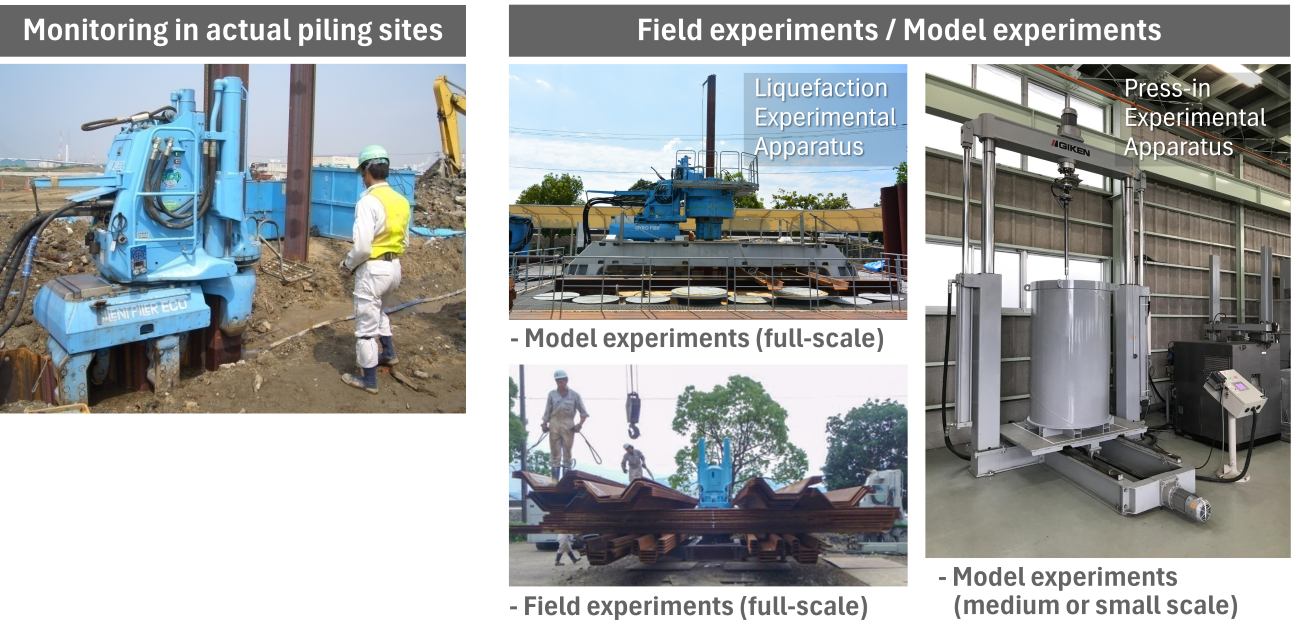
「施工」に関する研究開発は、多くの場合、実際の圧入施工現場における観察やモニタリングから始まります。
より詳細な検討には、実大野外実験や、液状化実験装置などの大型実験設備を用いた実験を採用します。さらに制御された条件下での検討には、圧入実験装置などの中規模・小規模の実験装置を活用します。
施工に関する研究開発
圧入施工に関する研究開発手法
圧入施工データを活用する要素技術
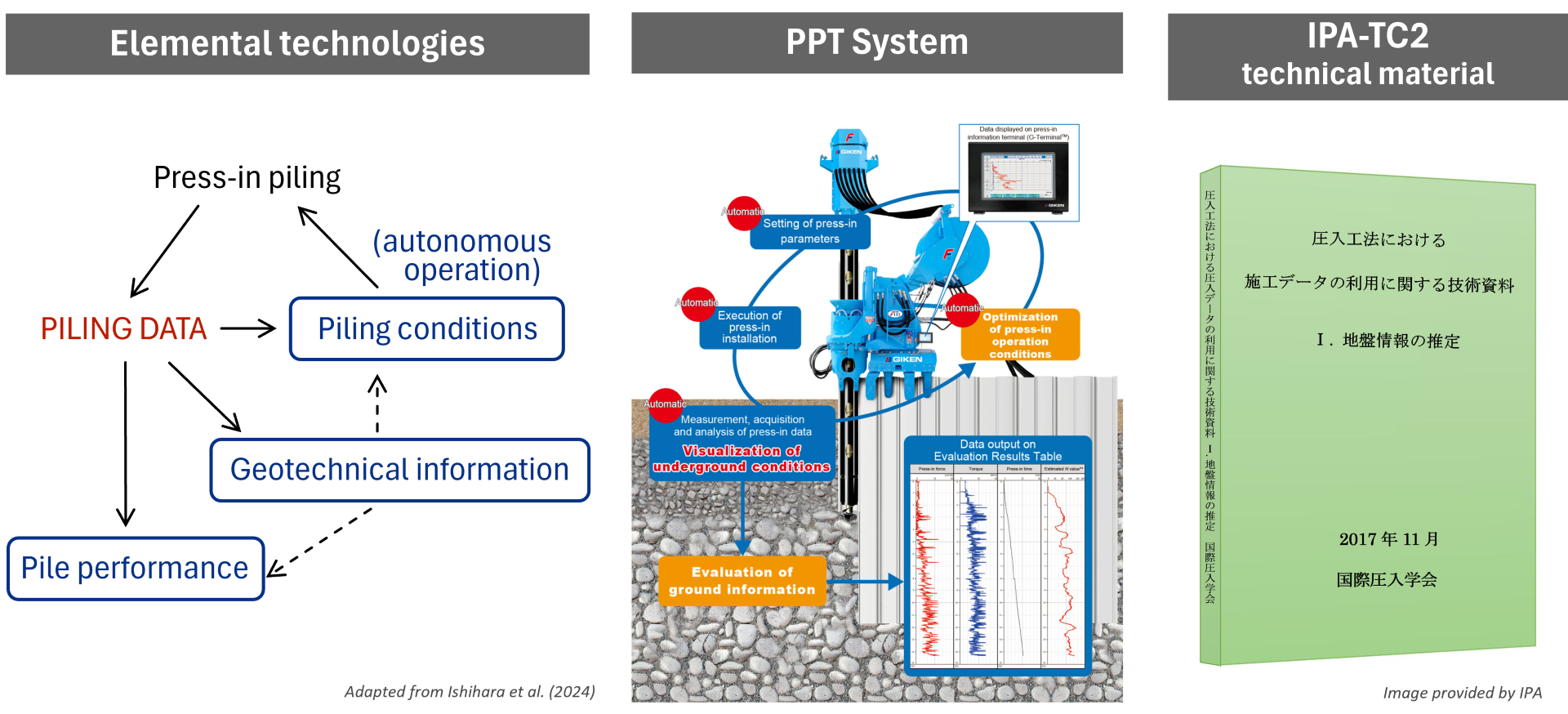
圧入工法では、圧入力、トルク、貫入深さなどのデータが杭1本ごとに取得されます。これらは総称して「施工データ」と呼ばれます。
当センターでは、これらのデータを活用するための基盤技術として、自動運転(Ishihara, 2018)、地盤情報の推定(Ishihara et al., 2015a)、杭性能の評価(Ishihara, 2023)などの開発を進めています(Ishihara et al., 2008)。自動運転および地盤情報推定の技術は、「PPT System」(PPT System | GIKEN LTD.)として実用化されており、2017年には国土交通省のNETIS(新技術情報提供システム)(SK-170006-VE)に登録されています。
また、地盤情報推定技術はIPA-TC2による評価を受け、2017年に技術資料として公表されています(IPA, 2017;Ishihara & Kusakabe, 2021)。
References
International Press-in Association (IPA). 2017. Technical Material on the Use of Piling Data in the Press-in Method: I. Estimation of Subsurface Information, 63p. (in Japanese)
Ishihara, Y., Ogawa, N., Kinoshita, S., Kitamura, A. and Tagaya, K. 2008. Study on development of the pile penetration test system based on press-in construction data. Society for Social Management Systems, CD-ROM, 10p.
Ishihara, Y., Haigh, S. K. and Bolton, M. D. 2015. Estimating base resistance and N value in rotary press-in. Soils and Foundations, Vol. 55, No. 4, pp. 788-797.
Ishihara, Y., Ogawa, N., Okada, K. and Kitamura, A. 2015a. Estimating subsurface information from data in press-in piling. Proceedings of the 5th International Workshop in Ho Chi Minh City, Press-in Engineering 2015, pp. 53-67.
Ishihara, Y. 2018. Use of press-in piling data for automatic operation of press-in machines and estimation of subsurface information. Proceedings of the First International Conference on Press-in Engineering 2018, Kochi, pp. 651-660.
Ishihara, Y. and Kusakabe, O. 2021. State of the art report on the use of press-in piling data for estimating subsurface information. Proceedings of the Second International Conference on Press-in Engineering 2021, Kochi, Japan, pp. 42-66.
Ishihara, Y. 2023. Use of press-in piling data for estimating subsurface information and pile performance. Doctoral Thesis, University of Tokyo, 421p.
圧入施工データを用いた地盤情報と杭性能の推定
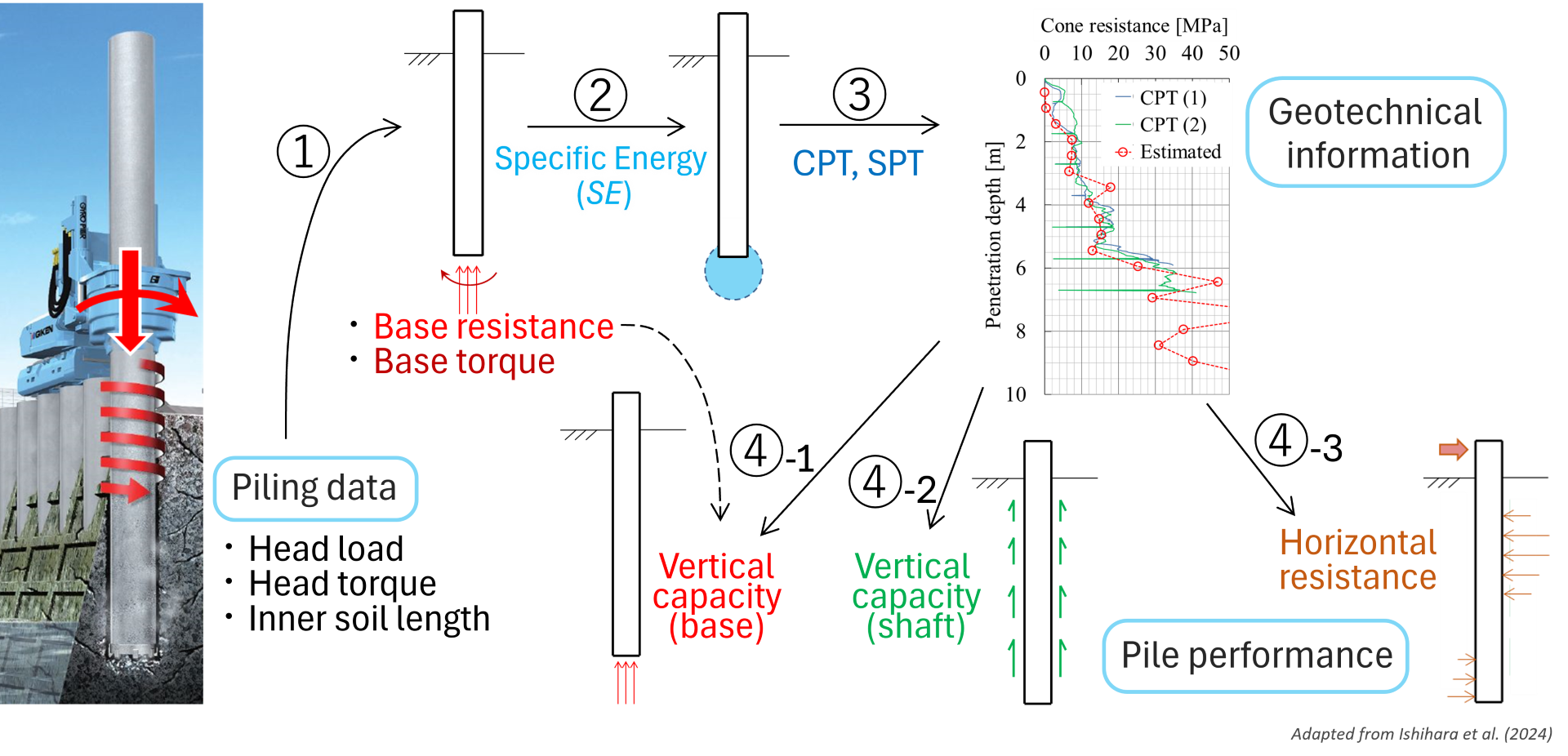
圧入杭施工には複数の貫入方式があり、それらの一部については地盤情報や杭性能を推定する手法が開発されています。
ここでは、回転切削圧入(RCP:Rotary Cutting Press-in)を例に、その推定手法を示します。この手法は4つのステップから構成されます(Ishihara, 2023)。回転切削圧入では、圧入機により杭頭荷重(Q)、杭頭トルク(T)、貫入深さ(z)が取得されます。第1ステップでは、追加の計測装置を用いることなく、杭頭荷重(Q)およびトルク(T)を先端成分および周面成分(Qb、Qs、Tb、Ts)に分解します。第2ステップでは、推定された先端成分(QbおよびTb)を用いて、杭先端における単位体積エネルギー(SE)を算定します。第3ステップでは、このSEをCPT(コーン貫入試験)の先端抵抗qcや、SPT(標準貫入試験)のN値へと変換します。最後に、第4ステップとして、推定された地盤情報(qcまたはN値)を、鉛直支持力および水平抵抗を評価するための計算式に適用します。
鉛直支持力については、回転切削圧入杭に特化した評価手法が、先端支持力(Ishihara et al., 2020)および周面摩擦力(Ishihara et al., 2025)それぞれに対して開発されています。
References
Ishihara, Y. 2023. Use of press-in piling data for estimating subsurface information and pile performance. Doctoral Thesis, University of Tokyo, 421p.
Ishihara, Y., Haigh, S. and Koseki, J. 2020. Assessment of base capacity of open-ended tubular piles installed by the Rotary Cutting Press-in Method. Soils and Foundations, Vol. 60, Issue 5, pp. 1189-1201.
Ishihara, Y., Okada, K. and Koseki, J. 2025. Correlating SPT results with shaft capacity of pipe piles installed by the Rotary Cutting Press-in Method. Proceedings of DFI India 2025: Deep Foundation Technologies for Infrastructure Development in India, Surat, Gujarat, pp. 618-627.
圧入施工データを活用した建設プロセスの合理化
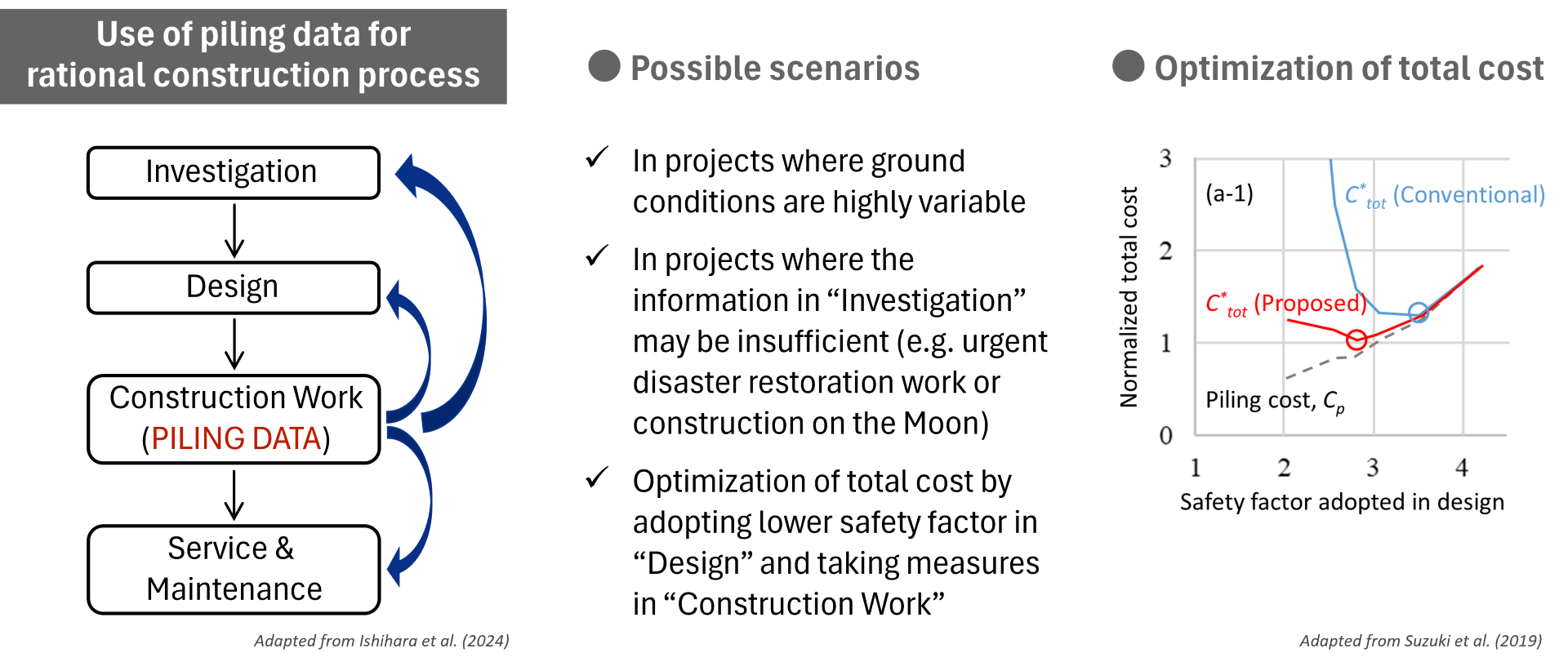
従来、建設プロジェクトは「調査」「設計」「施工」「供用・維持管理」という一方向の流れで進められてきました。しかし、場合によっては、「施工」の段階で得られる情報を活用して「調査」や「設計」の段階の情報を更新することで、プロジェクト全体の合理化が可能となります。
例えば、山地や河川周辺でのプロジェクトでは、地盤条件が大きく変動することがあります。支持層が傾斜していたり、大きな玉石や礫が点在している場合もあり、こうした不均質性は「調査」の段階で完全に把握することが困難です。その結果、「施工」の段階で「想定外の地盤条件」に直面することがあります。このとき、「施工」中に得られた情報を適切に解釈することで、設計変更や施工方法の見直しに関する客観的な判断根拠として活用することができます。
また、災害時の緊急復旧工事や月面での建設(Ishihara et al., 2024)などでは、事前の十分な地盤調査が難しい場合があります。このような状況では、「施工」の段階で得られる情報が地盤情報を補完する重要な役割を果たします。
さらに、「施工」時の情報をより積極的に活用することで、プロジェクト全体のコスト最適化も可能となります。例えば、「設計」の段階で安全率を低めに設定しつつ、「施工」時にその妥当性を確認し、必要に応じて追加対策を講じることで、合理的な建設が実現できます。このような手法は、プロジェクトの重要度や被害発生時のコストが大きい場合に特に有効です(Suzuki & Ishihara, 2019)。
References
Ishihara, Y., Eguchi, M., Mori, A. and Toda, Y. 2024. Use of press-in piling data for construction on the Moon: estimating subsurface information and pile capacity. Proceedings of the 3rd International Conference on Press-in Engineering 2024, Singapore, pp. 131-140.
Suzuki, N. and Ishihara, Y. 2019. Case study on the application of press-in piling data to design and construction of pile foundations for reducing the expected total cost. International Conference on Case Histories & Soil Properties, Singapore, 16p.
圧入施工データのデジタルツインへの活用

BEEYONDERSは、デジタルツインを活用して建設の生産性向上を目指すEU(欧州連合)の支援プロジェクトです。当センターはサポーターとして本プロジェクトに参画し、RCP(回転切削圧入)施工時のデータからCPT(コーン貫入試験)の先端抵抗を推定する技術を提供しました。詳細については、プロジェクトのウェブサイト(https://beeyonders.eu/case-studies/)をご参照ください。
構造物に関する研究開発
圧入された杭および鋼矢板の性能評価手法
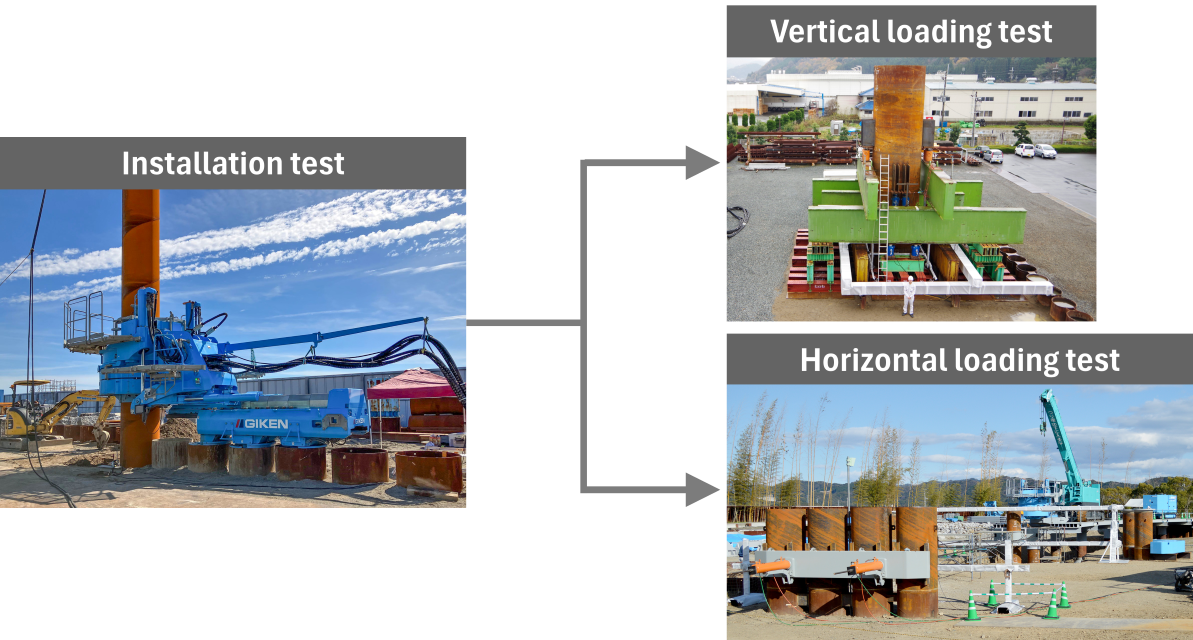
構造物に関する研究開発において最も基礎的かつ重要な要素は、単杭(鋼矢板を含む)の性能評価です。杭の性能は地盤条件や施工過程に大きく依存するため、その検討にあたっては、多様な地盤条件および圧入工法における各種貫入技術を対象とする必要があります。これには、単独圧入(SP)、ウォータージェット併用圧入(PWJ)、オーガ併用圧入(PA、硬質地盤クリア工法)、回転切削圧入(RCP、ジャイロプレス工法™)などが含まれます。
これらの検討は一般に、「貫入試験」と「載荷試験」を組み合わせて実施されます。貫入試験では、所定の圧入条件のもとで特定の貫入技術により試験杭を施工します。その後、所定の期間を経て、試験杭に対して載荷試験を行います。載荷試験には、検討の目的や予算に応じて、静的載荷試験または急速載荷試験が選択されます。
単独圧入で施工された杭や矢板の性能
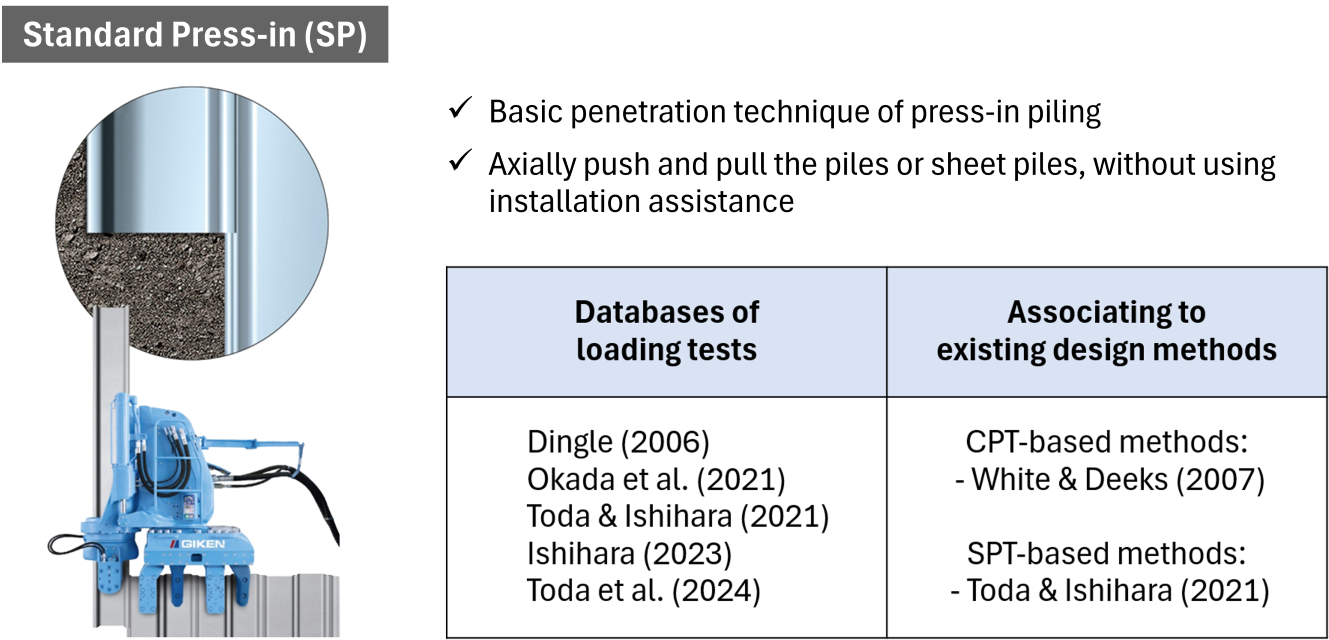
単独圧入は、圧入工法の基本となる貫入技術であり、ウォータージェットやオーガ等の補助工法を用いず、軸方向の荷重により杭または鋼矢板を施工する手法です。これまでに、Dingle (2006)、Okada et al. (2021)、Toda & Ishihara (2021)、Ishihara (2023)、Toda et al. (2024) により、載荷試験に関するデータベースが蓄積されています。
これらのデータベースは、White & Deeks (2007) や Toda & Ishihara (2021) などの研究において、単独圧入で施工された杭や矢板の性能を既存の設計手法と関連付けるために活用されています。
References
Dingle, H. 2006. The testing and analysis of jacked foundation piles. M.Eng. Project Report, University of Cambridge Department of Engineering, 50p.
Ishihara, Y. 2023. Use of press-in piling data for estimating subsurface information and pile performance. Doctoral Thesis, University of Tokyo, 421p.
Okada, K., Inomata, K. and Ishihara, Y. 2021. Results of static vertical load tests on tubular piles installed by Standard Press-in and Rotary Cutting Press-in. Proceedings of the Second International Conference on Press-in Engineering 2021, Kochi, Japan, pp. 124-130.
Toda, K. and Ishihara, Y. 2021. An investigation into vertical capacity of steel sheet piles installed by the Standard Press-in method. Proceedings of the Second International Conference on Press-in Engineering 2021, Kochi, Japan, pp. 177-184.
Toda, Y., Eguchi, M., Mori, A. and Ishihara, Y. 2024. Vertical load tests on zero sheet pile pressed-in into alluvial soft ground. Proceedings of the 3rd International Conference on Press-in Engineering 2024, Singapore, pp. 409-416.
White, D. J. and Deeks, A. D. 2007. Recent research into the behaviour of jacked foundation piles. Advances in Deep Foundations, pp. 3-26.
オーガ併用圧入で施工された矢板の性能
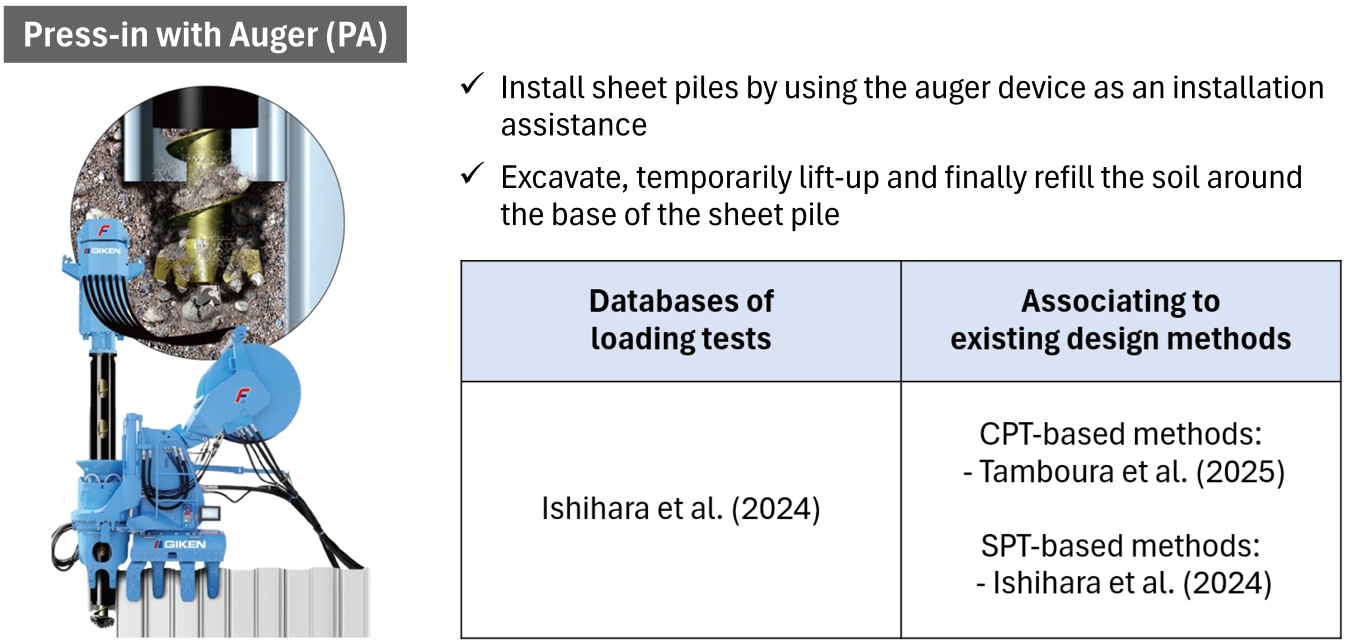
オーガ併用圧入(PA:Press-in with Auger、硬質地盤クリア工法)は、圧入工法における貫入技術の一つであり、オーガを用いて鋼矢板を施工する手法です。本手法では、鋼矢板先端周辺の地盤を掘削して一時的に地表側に向けて移送し、そのあと埋戻しを行います。
載荷試験データベースは Ishihara et al. (2024a) により整備されています。これらのデータベースは、オーガ併用圧入で施工された鋼矢板の性能を既存の設計法に関連付けるために活用されており、SPTに基づく設計法(Ishihara et al., 2024a)およびCPTに基づく設計法(Tamboura et al., 2025)との対応付けが行われています。
References
Ishihara, Y., Okada, K., Eguchi, M., Mori, A. and Miyanohara, T. 2024a. Field tests on vertical and horizontal resistance of steel sheet piles installed by the Press-in with Auger. Proceedings of the 18th European Conference on Soil Mechanics and Geotechnical Engineering, 6p.
Tamboura, H. H., Ishihara, Y., Eguchi, M. and Mori, A. 2025. CPT-based analysis on vertical and lateral capacity of steel sheet piles installed by the Press-in with Auger. Proceedings of the International Conference on Deep Foundations and Ground Improvement, Geotechnics Reimagined, DFI-EFFC, pp. 947-956.
回転切削圧入で施工された杭の性能
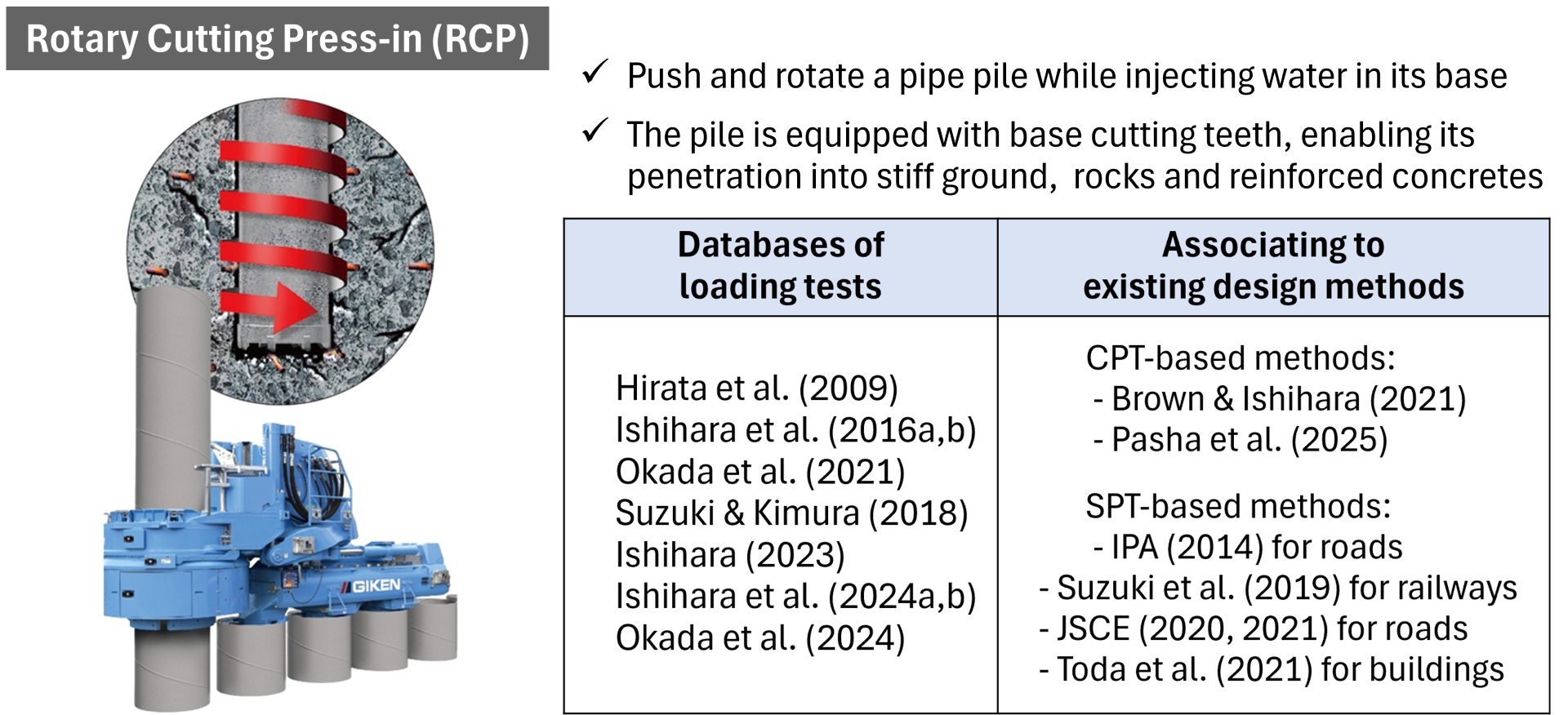
回転切削圧入工法(ジャイロプレス工法™)は、鉛直荷重と回転力を組み合わせて鋼管杭を施工する圧入工法の一つです。杭先端には切削ビットが装備されており、硬質地盤、岩盤、さらには鉄筋コンクリート構造物への貫入が可能です。
これまでに、Hirata et al. (2009)、Ishihara et al. (2016a,b)、Okada et al. (2021)、Suzuki & Kimura (2018)、Ishihara (2023)、Ishihara et al. (2024a,b)、Okada et al. (2024) などにより、載荷試験データが蓄積されています。これらのデータは、Brown & Ishihara (2021)、Pasha et al. (2025)、IPA (2014)、Suzuki et al. (2019)、JSCE (2020)、JSCE (2021)、Toda et al. (2021b) などにおいて、RCP杭の性能と既存設計手法との関連付けに活用されています。
なお、土木学会技術評価報告書(JSCE, 2020; JSCE, 2021)の設計法は、現在日本国内を中心に実務で適用されています。
References
Brown, M. and Ishihara, Y. 2021. Predicting the capacity of push and rotate piles using offshore design techniques and CPT tests. Proceedings of the Second International Conference on Press-in Engineering 2021, Kochi, pp. 185-193.
Hirata, H., Suzuki, T., Matsui, N. and Yasuoka, H. 2009. Bearing capacity performance of rotary press-in method (Gyropress Method): part 1 (vertical capacity). Proceedings of the 65th JSCE (Japanese Society of Civil Engineers) Annual Meeting, pp. 41-42. (in Japanese)
International Press-in Association (IPA). 2014. Design and Construction Manual for Earth Retaining Walls with Tubular Piles Installed by Gyropress (Rotary Cutting Press-in) Method, 143p. (in Japanese)
Ishihara, Y., Ogawa, N., Okada, K., Inomata, K., Yamane, T. and Kitamura, A. 2016a. Model test and full-scale field test on vertical and horizontal resistance of hatted tubular pile. Proceedings of the Third International Conference Geotec Hanoi 2016 - Geotechnics for Sustainable Infrastructure development, pp. 131-139.
Ishihara, Y., Okada, K., Yokotobi, T. and Kitamura, A. 2016b. Pull-out resistance of a large diameter steel tubular pile installed by Rotary Cutting Press-in. Proceedings of the Third International Conference Geotec Hanoi 2016 - Geotechnics for Sustainable Infrastructure development, pp. 141-147.
Ishihara, Y. 2023. Use of press-in piling data for estimating subsurface information and pile performance. Doctoral Thesis, University of Tokyo, 421p.
Ishihara, Y., Eguchi, M., Mori, A. and Toda, Y. 2024a. Use of press-in piling data for construction on the Moon: estimating subsurface information and pile capacity. Proceedings of the 3rd International Conference on Press-in Engineering 2024, Singapore, pp. 131-140.
Ishihara, Y., Okada, K., Toda, Y. and Kitano, Y. 2024b. Case history of installation and static vertical load testing on piles executed by the Rotary Cutting Press-in in Amsterdam. Proceedings of the 18th European Conference on Soil Mechanics and Geotechnical Engineering, 7p.
Japan Society for Civil Engineers (JSCE). 2020. Report of technology assessment of design and construction method for Rotary Cutting Press-in (Gyropress) Method. Technology Promotion Library, No. 25, 113p. (in Japanese)
Japan Society for Civil Engineers (JSCE). 2021. Technical Evaluation for the Design and Construction Method for Rotary Press-in Piling Method (Gyropress Method), Report, Certificate No. 25.
Okada, K., Inomata, K. and Ishihara, Y. 2021. Results of static vertical load tests on tubular piles installed by Standard Press-in and Rotary Cutting Press-in. Proceedings of the Second International Conference on Press-in Engineering 2021, Kochi, Japan, pp. 124-130.
Okada, K., Murata, T., Mori, A., Toda, Y. and Ishihara, Y. 2024. Development of rapid load test device and its applicability to piles installed by Rotary Cutting Press-in. Proceedings of the 3rd International Conference on Press-in Engineering 2024, Singapore, pp. 124-130.
Pasha, S. M. K., Ishihara, Y., Eguchi, M. and Toda, Y. 2025. CPT based design method for horizontal capacity of piles installed by the Rotary Cutting Press-in Method. Proceedings of the International Conference on Deep Foundations and Ground Improvement, Geotechnics Reimagined, DFI-EFFC, pp. 736-746.
Suzuki, N., Kimura, Y., Sanagawa, T. and Nishioka, H. 2019. Modeling of vertical bearing capacity of rotary Press-in pile used for a railway structure. Journal of Railway Engineering Research 23, pp. 217-222. (in Japanese)
Suzuki, N. and Kimura, Y. 2018. Study on the horizontal bearing performance of steel tubular piles installed by the Gyropress Method and the Press-in Method assisted with water jetting. Proceedings of the First International Conference on Press-in Engineering 2018, Kochi, pp. 125-132.
Toda, K., Ishihara, Y. and Suzuki, N. 2021b. Comparison of SPT-based design methods for vertical capacity of piles installed by Rotary Cutting Press-in. Proceedings of the Second International Conference on Press-in Engineering 2021, Kochi, Japan, pp. 169-176.
構造物の性能評価手法
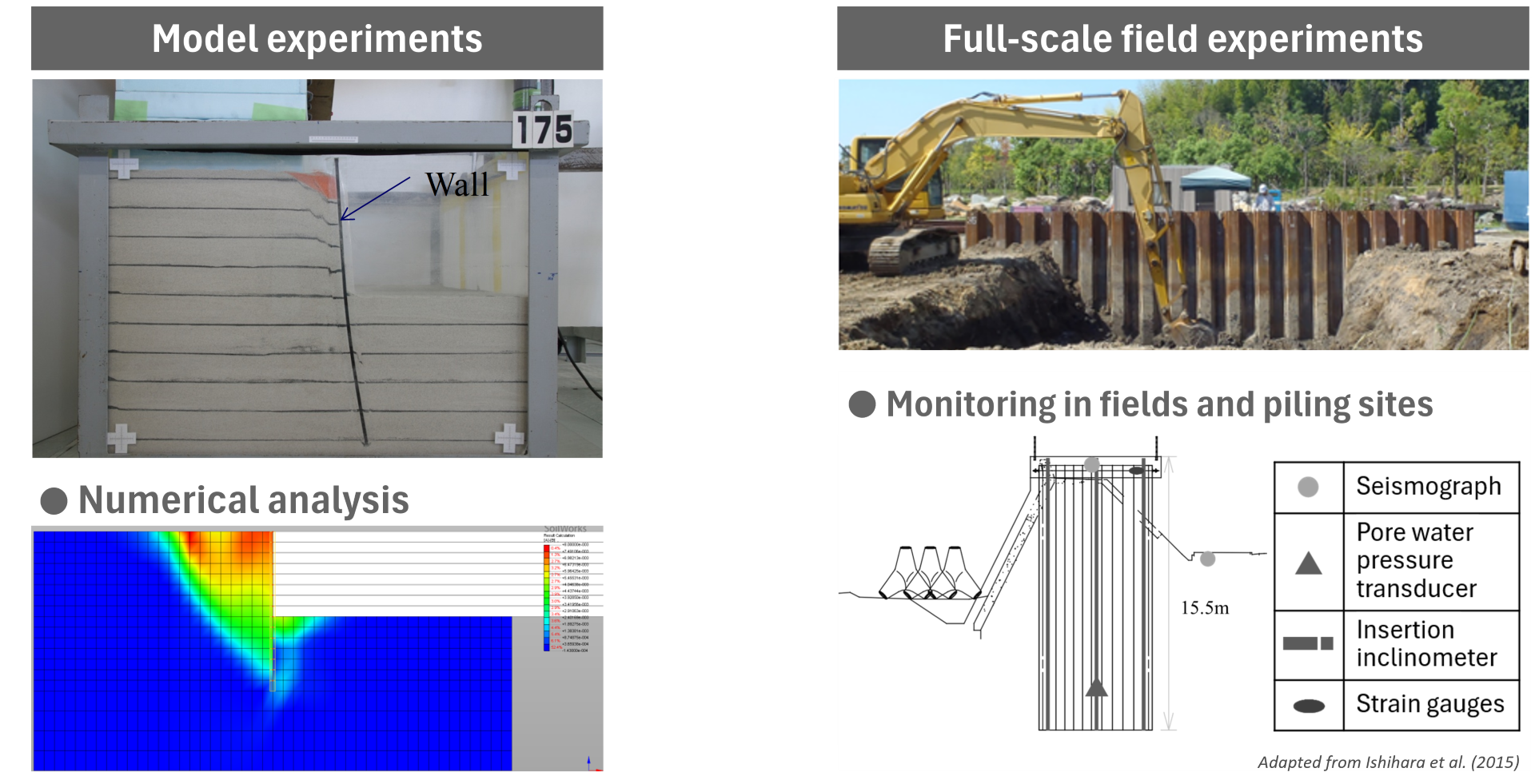
「構造物」に関する研究開発は、模型実験および数値解析から始まることが多く、構造物の有効性に応じて、大型実験や実大実験へと展開される場合があります。さらに、実構造物のモニタリングを実施し、その性能の検証や将来の改良に役立てることもあります。
「インプラントハット橋梁」に用いる笠付鋼管杭の性能
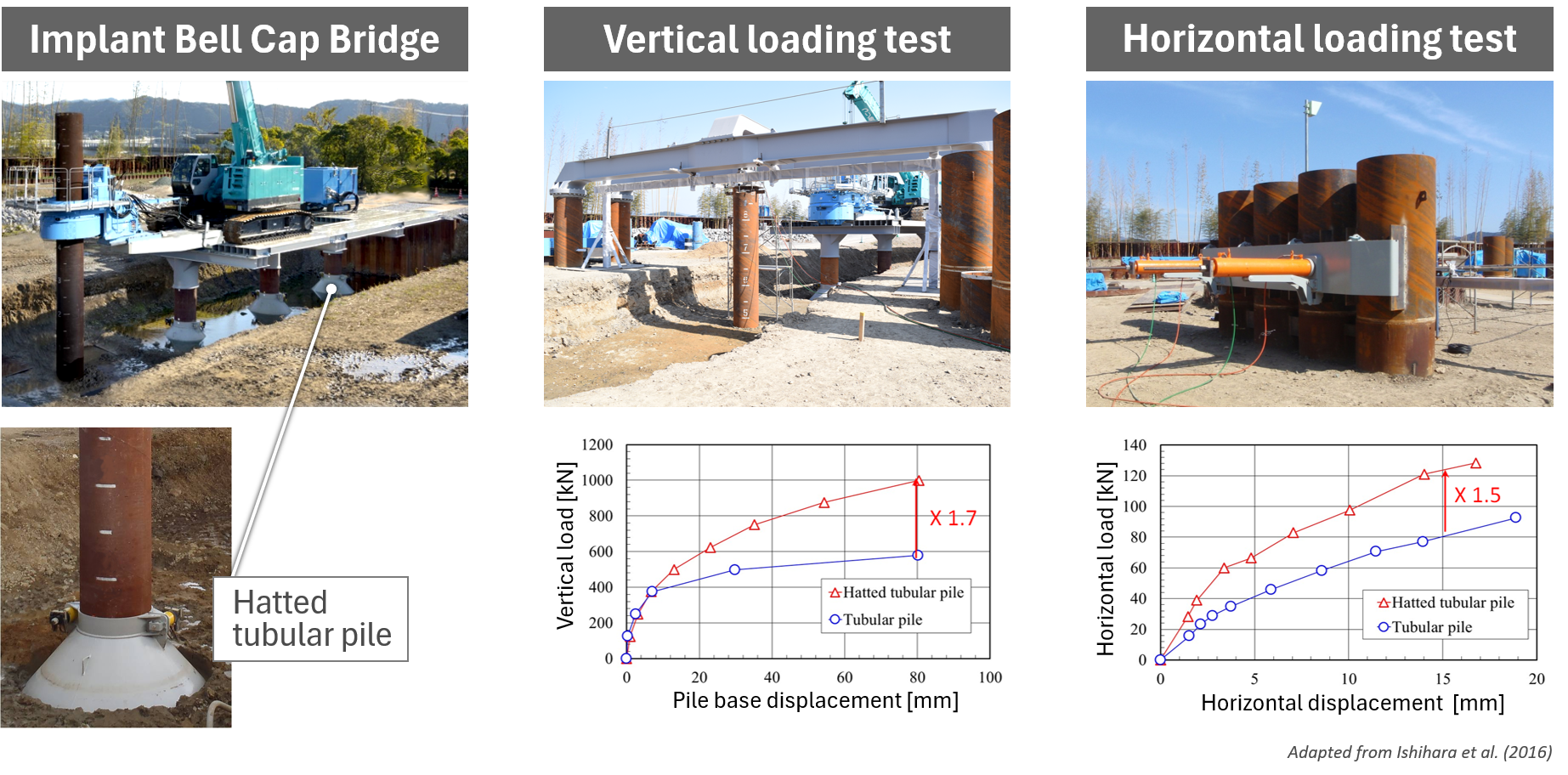
「インプラントハット橋梁」は、ピア杭として笠付鋼管杭を用い、その上にT型梁を介して床版を設置することで橋梁機能を確保する構造形式の橋梁です。笠付鋼管杭は、開端鋼管杭とベル状のキャップ(笠)を地表面付近で剛結した構造となっています。
本橋梁に特化した圧入施工システムにより、狭小な施工空間においても短期間で施工が可能です。また、撤去時には施工手順を逆にたどることで容易に解体することができます。笠付鋼管杭の鉛直および水平抵抗特性は、1g模型実験および野外実大実験により検証されています (Ishihara et al., 2016)。通常の杭と比較して、杭頭変位が杭径の1/100以下の範囲における鉛直剛性は同程度であり、鉛直支持力は約1.7倍に向上しています。
一方で、水平抵抗については、載荷初期段階から常に大きな値を示し、地表面における水平変位が15mmに達した時点で、通常杭の約1.5倍の抵抗性能を示しています。
Reference
Ishihara, Y., Ogawa, N., Okada, K., Inomata, K., Yamane, T. and Kitamura, A. 2016. Model test and full-scale field test on vertical and horizontal resistance of hatted tubular pile. Proceedings of the Third International Conference Geotec Hanoi 2016 - Geotechnics for Sustainable Infrastructure development, pp. 131-139.
「インプラント津波減衰堤」の性能
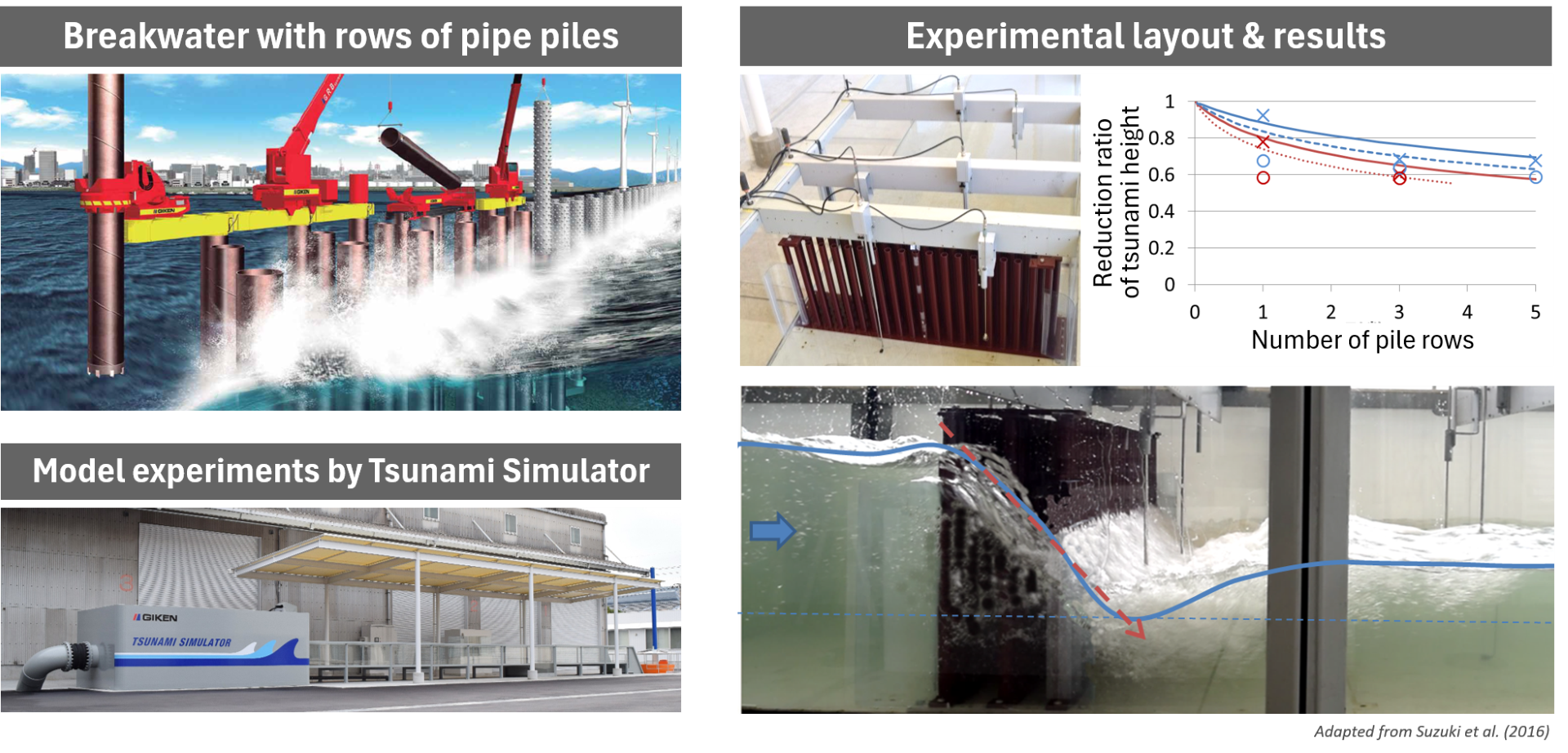
「インプラント津波減衰堤」は、主に津波対策を目的として、鋼管杭を列状に配置した沖合構造物です。各杭は、津波荷重に抵抗できる十分な根入れ長をもって地盤中に設置されます。
Suzuki et al. (2016) は、杭間隔、杭列数、および津波高さの影響を把握するために重力場模型実験を実施しました。その結果、津波の透過率は杭間隔に比例して増加することが明らかとなりました。また、杭列数が増えることで各列に作用する津波荷重は低減し、特に下流側の列ほど荷重が小さくなることが確認されました。さらに、津波荷重の評価においては、複数列の場合には抗力係数の適用が有効であり、単列の場合には修正谷本式と低減係数の適用が妥当であることが示されています。
Reference
Suzuki, N., Ishihara, Y. and Isobe, M. 2016. Experimental study on tsunami mitigation effect of breakwater with arrays of steel tubular piles. Journal of Social Safety Science, No. 29, 2016.11, pp. 7-14. (in Japanese)
津波減衰のための「インプラントバリア」の性能
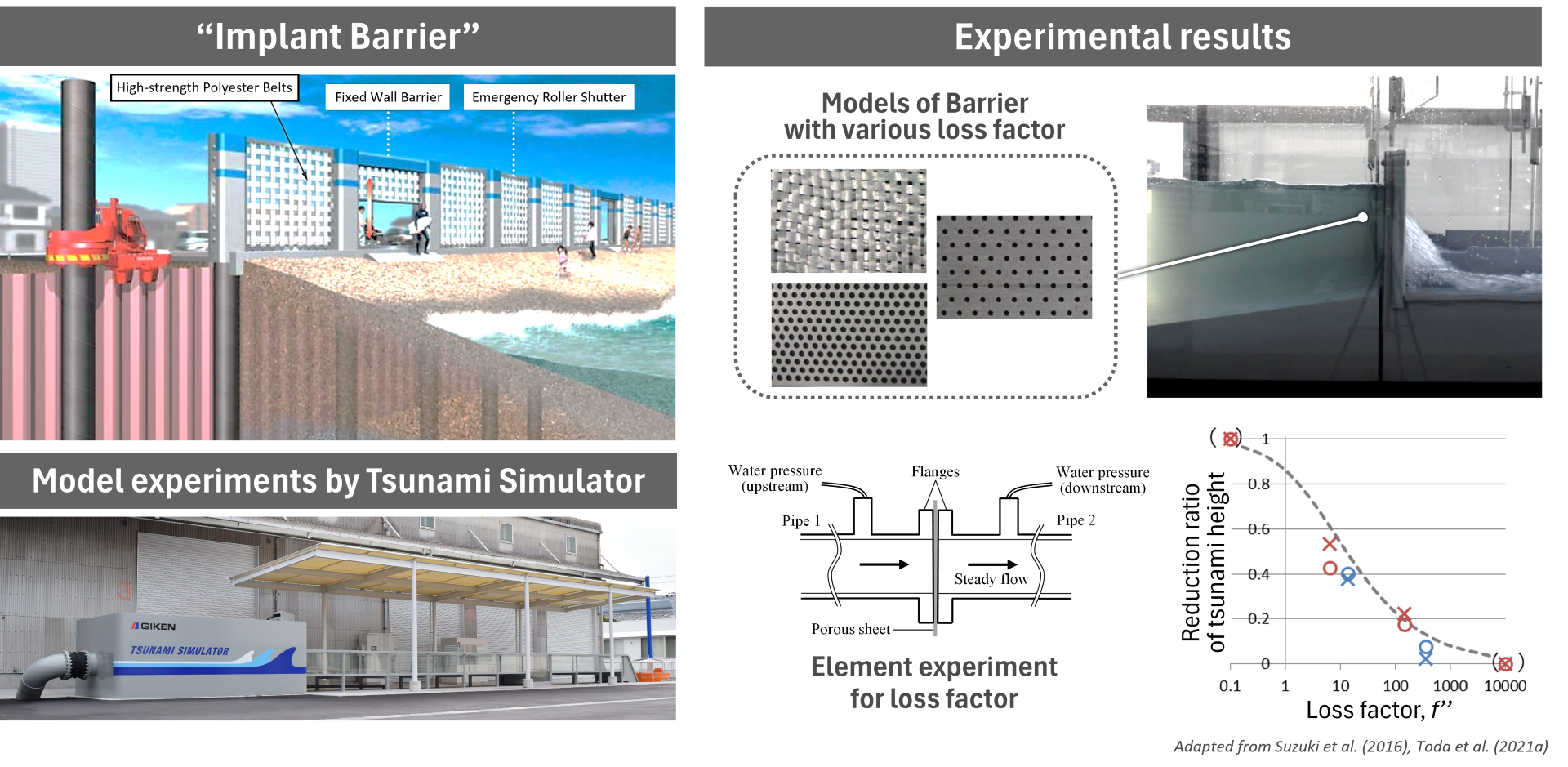
「インプラントバリア」は、主に津波を対象とした防災・減災構造物であり、主として支柱部材と壁面部材から構成されます。支柱部材は一定間隔で配置された圧入鋼管杭であり、壁面部材はコンクリート、金属、または繊維材料で構成され、支柱部材に取り付けられます。
壁面部材に繊維製の多孔質シートを用いる場合、流れがバリアを通過する際のエネルギー損失により、津波荷重および波高の低減が期待されます。
Suzuki et al. (2016) は、この現象を表現するために「損失係数」を導入した理論モデルを提案し、模型実験により津波高さの低減が損失係数の関数として表されることを確認しました。また、壁面部材の損失係数を評価するための要素実験も提案しています。さらに、Toda et al. (2021a) は、バリアを津波が越流する場合を考慮するため、Suzuki et al. (2016) の理論を拡張し、「等価開口率」および「等価損失係数」を導入しました。実験結果との比較により、拡張された理論はバリア背後の水深を概ね適切に評価できる一方で、バリア前面の水深やバリアに作用する津波荷重についてはやや過小評価する傾向があることが示されました。また、壁面部材の形状(直線状またはたわみ形状)の影響についても検討され、たわみ形状の方がわずかに高い減衰効果を示すことが確認されています。
References
Suzuki, N., Ishihara, Y. and Isobe, M. 2016. Experimental study on influence of porosity and material of pile-type porous tide barrier on its tsunami mitigation effect. Journal of Japan Society of Civil Engineers, Ser. B3 (Ocean Engineering), Vol. 72, No. 2, pp. I-491-I-496. (in Japanese)
Toda, K., Mori, A., Ishihara, Y. and Suzuki, N. 2021a. Experimental study on tsunami mitigation effect of pile-type porous tide barrier. Proceedings of the Second International Conference on Press-in Engineering 2021, Kochi, Japan, pp. 444-453.
矩形鋼矢板壁(「拘束地盤免震」)の性能
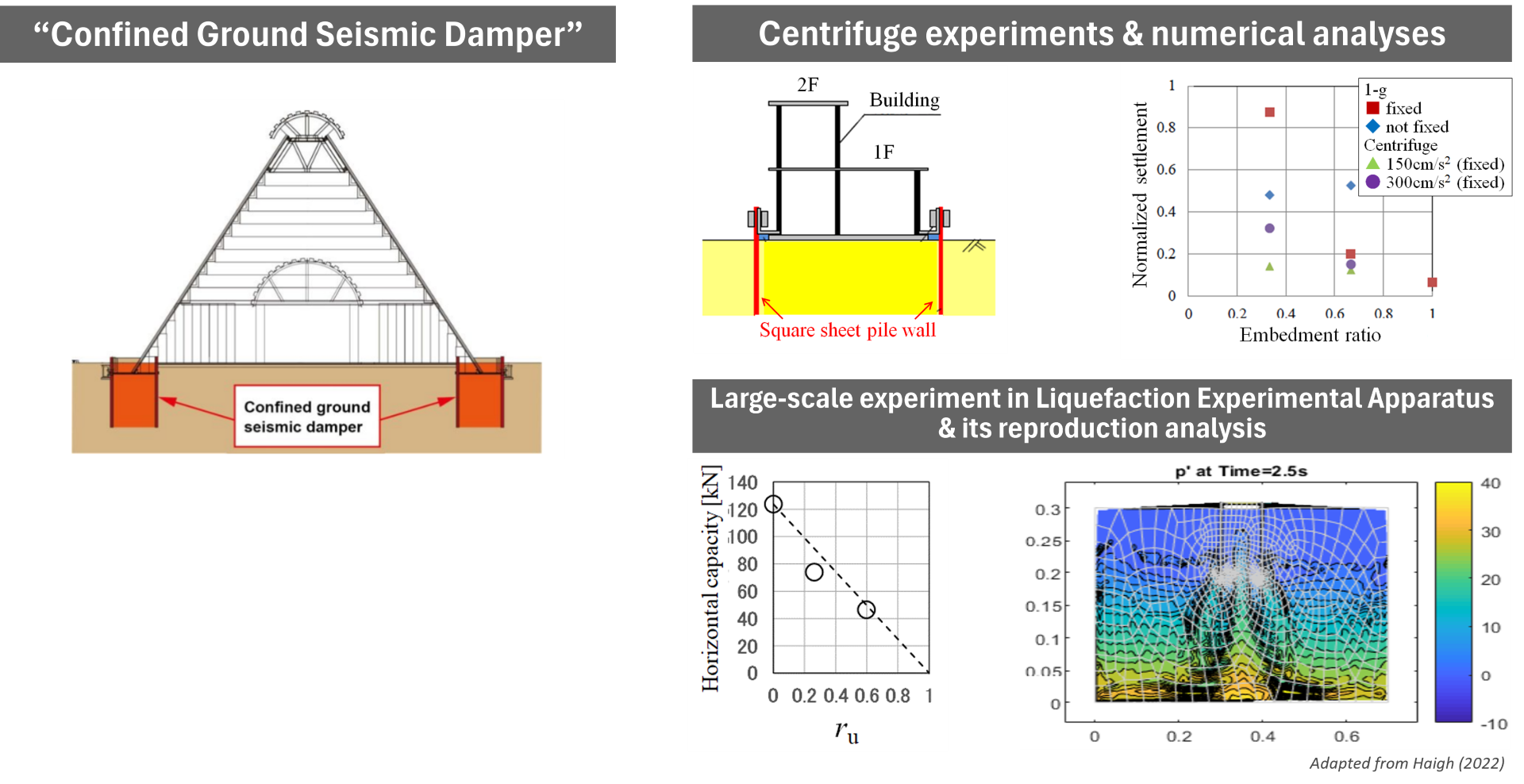
「拘束地盤免震(Confined Ground Seismic Damper)」は、矩形に配置された圧入鋼矢板壁と、その内部に拘束された地盤から構成される構造です。構造物の基礎として、または既存基礎の補強手段として機能します。
本構造の有効性については、Kato et al. (2014) により、重力場模型実験、遠心模型実験および数値解析を通じて検討されています。その結果、液状化に伴う構造物(住宅など)の沈下および傾斜は、根入れ比(液状化層厚に対する根入れ長の比)が1未満、すなわち鋼矢板壁が非液状化層に到達していない場合でも低減できることが示されました。また、根入れ比が1を超える場合には、より大きな低減効果が得られることが確認されています。
Toda et al. (2022, 2023) は、液状化実験装置を用いた大型模型実験により、さまざまな液状化状態(過剰間隙水圧比ruで評価)における、正方形鋼矢板壁に支持されたスラブの鉛直および水平抵抗特性を検討しました。その結果、ruの増加に伴い鉛直・水平抵抗はともに低下し、両者の関係は概ね線形であることが示されました。さらに、Haigh (2022) は、Toda et al. (2022, 2023) の実験を遠心模型実験および数値解析により再現し、鋼矢板壁の内部および下部に完全液状化状態ではない土柱が形成されることを示しました。この土柱の存在が、液状化地盤中においても構造物が一定の支持性能を維持する要因の一つであると考えられます。
References
Haigh, A. 2022. Performance of Implant structures. M.Eng. Thesis, University of Cambridge, 52p.
Kato, I., Hamada, M., Higuchi, S., Kimura, H. and Kimura, Y. 2014. Effectiveness of the sheet pile wall against house subsidence and tilting induced by liquefaction. Journal of Japan Association for Earthquake Engineering, Vol. 14, No. 4, pp. 4_35-4_49. (in Japanese)
Toda, K., Ishihara, Y., Eguchi, M. and Mori, A. 2022. Experimental study on a foundation reinforced by square sheet pile wall. Japan Society of Civil Engineers 2021 Annual Meeting, 2p. (in Japanese)
Toda, K., Ishihara, Y., Eguchi, M. and Mori, A. 2023. Horizontal resistance of a slab reinforced by square sheet pile wall in a liquefied ground. Japan Society of Civil Engineers 2023 Annual Meeting, 2p. (in Japanese)
鋼矢板擁壁(プレロード擁壁)の性能
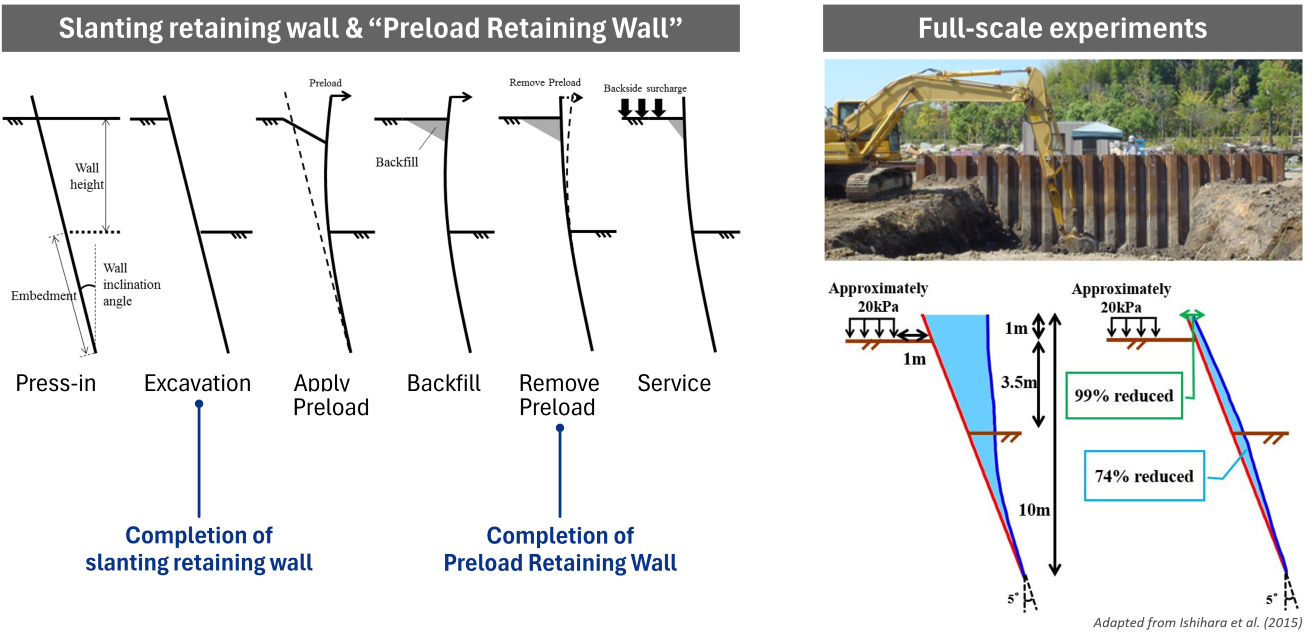
「プレロード擁壁」は、傾斜角を有し、かつ弓なりに配置された鋼矢板壁からなる構造です。その施工手順は、(1) 一定の傾斜角で鋼矢板を打設する、(2) 壁の片側を掘削する、(3) 壁に水平荷重(プレロード)を作用させる、(4) 壁背面を埋め戻す、(5) プレロードを除去する、という工程で構成されます。
Gao (2014) および Ishihara et al. (2015) は、重力場模型実験および野外実大実験により、背面に上載荷重を作用させた際の変形挙動をプレロードなしの傾斜式擁壁(斜壁)と比較しています。その結果、20 kPaの上載荷重を受けた場合、プレロード擁壁の水平変位は斜壁の場合よりも小さいことが示されました。また、最大水平変位はプレロード擁壁では掘削底付近に発生するのに対し、斜壁では壁頂部に発生することが確認されました。さらに Ishihara et al. (2015) は、数値解析により、プレロード擁壁の高い性能は以下の2つの機構によるものであると示唆しています。すなわち、(A) プレロードによる載荷履歴により掘削底部付近の地盤剛性が増加すること、(B) 鋼矢板壁の弾性反力により水平応力が増加し、背面地盤のせん断強度が向上することです。また、これらのうち主に(A)の機構に着目し、設計時に必要なプレロード量を簡易に算定する手法も提案されています。
References
Gao, G. 2014. Comparing performance of different sheet pile walls. M.Eng. Thesis, University of Cambridge, 50p.
Ishihara, Y., Ogawa, N., Okada, K. and Kitamura, A. 2015. Implant Preload Wall: a novel self-retaining wall with high performance against backside surcharge. Press-in Engineering 2015, pp. 68-82.
Ogawa, N., Ishihara, Y. and Kitamura, A. 2017. Experimental study on deformation of self-retaining sheet pile wall due to excavation and backside surcharge. Journal of Japan Society of Civil Engineers, Division C: Geotechnics, pp. 62-75. (in Japanese)
Ogawa, N., Eguchi, M. and Ishihara, Y. 2024. Experimental study on the effect of preloading on the horizontal displacement of steel sheet pile walls. Proceedings of the 3rd International Conference on Press-in Engineering 2024, Singapore, pp. 116-123.
宇宙に関する研究開発
宇宙建設革新プロジェクトへの参画
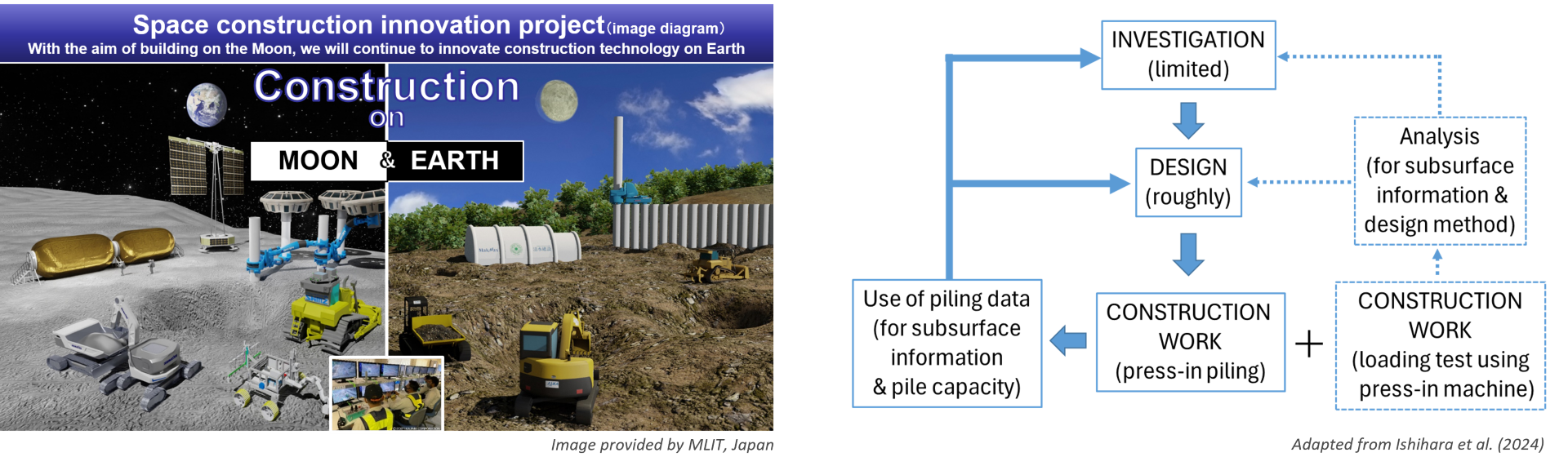
「宇宙建設革新プロジェクト」は、国土交通省(MLIT)および文部科学省(MEXT)が主導するプロジェクトであり、2021年度に開始されました。現在、12の機関が参画しています。当社は2021年度にフィージビリティ・スタディ(F/S)段階を完了し、2022年度からは研究開発(R&D)段階に移行しています。本段階では、圧入施工データを活用した技術を、月面における建設プロジェクトへ適用することを目指して検討を進めています。
References
Ishihara, Y., Eguchi, M., Mori, A. and Toda, Y. 2024a. Use of press-in piling data for construction on the Moon: estimating subsurface information and pile capacity. Proceedings of the 3rd International Conference on Press-in Engineering 2024, Singapore, pp. 131-140.
Ishihara, Y., Eguchi, M., Mori, A. and Toda, Y. 2024b. Simple static vertical and horizontal loading tests on small pipe piles using press-in machine. Proceedings of the 3rd International Conference on Press-in Engineering 2024, Singapore, pp. 141-147.
Tamboura, H. H., Ishihara, Y. and Ogawa, N. 2024a. Numerical investigation of bearing capacity of pressed-in piles for earth-based innovations and geotechnical strategies for construction projects on the Moon. Proceedings of the 3rd International Conference on Press-in Engineering 2024, Singapore, pp. 148-157.
Sarmah, R., Okada, K., Tamboura, H. H. and Ishihara, Y. 2025. Model tests to assess the temperature generation due to tubular pile installation in lunar regolith simulant by Rotary Cutting Press-in Method. Proceedings of DFI India 2025: Deep Foundation Technologies for Infrastructure Development in India, Surat, Gujarat, pp. 649-658.
Space Port Kochiへの参画

スペースポート高知は、ロケットの発着を目的とした宇宙港を高知県に整備することを目指す一般社団法人です。当社はそのビジョンに賛同し、法人会員として参画しています。本プロジェクトは、高知地域の経済活性化に寄与するのみならず、日本の国際的なプレゼンス向上にもつながる取り組みとして大きな期待を集めています。当センターは、圧入技術がこれらの発展に貢献する将来像を描いています。
詳細については、公式ウェブサイト(https://spkochi.org/)をご参照ください。
圧入工法の適用事例
学術界との連携
ケンブリッジ大学との共同研究
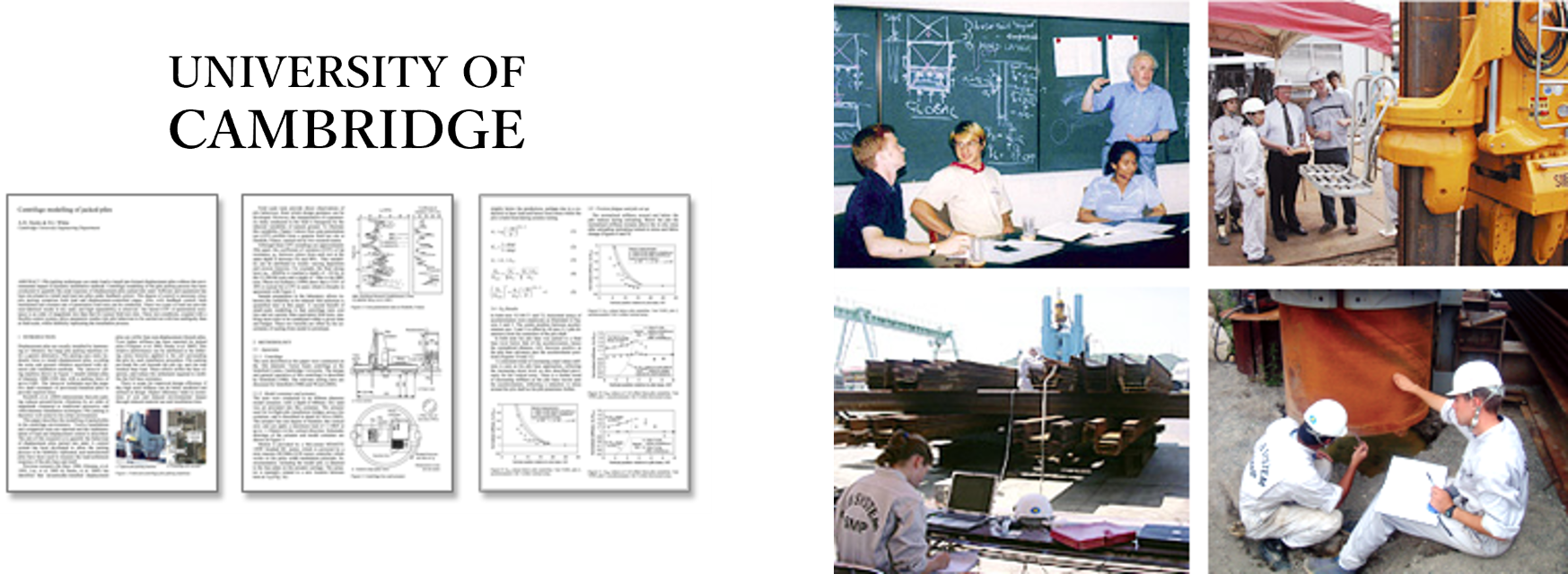
ケンブリッジ大学とGIKENの共同研究は、建設に関する諸課題についての北村精男氏(技研製作所会長)の強い問題意識のもと、1994年に開始されました。毎年夏にはケンブリッジ大学の学生2名が高知に滞在し、圧入機や各種実験設備を用いた野外実験や模型実験に参加しています。
本プログラムを通じて、学生は圧入技術を実体験として学びます。一方で、研究開発センターのメンバーは、異文化や高度な思考に触れることで、より深い洞察と新たな発想を得ています。詳細については、Ishihara & Haigh (2018) をご参照ください。
Reference
Ishihara, Y. and Haigh, S. 2018. Cambridge-Giken collaborative working on pile-soil interaction mechanisms. Proceedings of the First International Conference on Press-in Engineering 2018, Kochi, pp. 23-46.
ケンブリッジ大学との共同研究のテーマ
- 1995-1996: ウォータージェットの効果
- 1997-1998: 圧力球根の解明
- 1998-1999: 圧入力と杭形状 / 圧入速度
- 1999-2000: 閉塞強度測定
- 2000-2001: フリクションカット / ひずみ測定
- 2001-2002: 圧入力と極限支持力
- 2002-2003: 圧入群杭の優位性 / 振動測定
- 2003-2004: 圧入群杭の載荷試験
- 2004-2006: 杭の貫入抵抗力 / 閉塞と極限支持力
- 2006-2007: 引抜力増大のメカニズム
- 2007-2008: 杭の貫入抵抗力と支持力セットアップ
- 2008-2009: 圧入中の閉塞
- 2009-2010: 打抜の効果
- 2010-2011: 回転圧入による地盤抵抗低減
- 2011-2012: 圧入杭周辺地盤内の水圧変化の空間分布
- 2012-2013: 砂地盤での回転圧入時の摩擦の低減
- 2013-2014: 鋼矢板連続壁の性能
- 2014-2015: 密な砂地盤での回転圧入中の水締めメカニズム
- 2015-2016: インプラント堤防の津波に対する粘り強さの実証
- 2016-2017: 掘削底面の安定の有無による鋼矢板壁の性能
- 2017-2018: ウォータージェットのメカニズム
- 2018-2019: 回転切削圧入時の閉塞
- 2019-2020: 圧入鋼矢板の性能
- 2020-2021: 液状化砂地盤における圧入鋼管杭の性能
- 2021-2022: 液状化砂地盤における圧入鋼矢板基礎の性能
- 2022-2023: 格子隔壁の有無による二重鋼矢板堤防の性能
- 2023-2024: 液状化実験装置の地盤のパラメータと、地盤挙動に対する噴砂の影響
- 2024-2025: 能登地域における鋼矢板構造物の被災調査およびメカニズム解明
- 2025-2026: 回転切削圧入により構築した井筒基礎の性能