
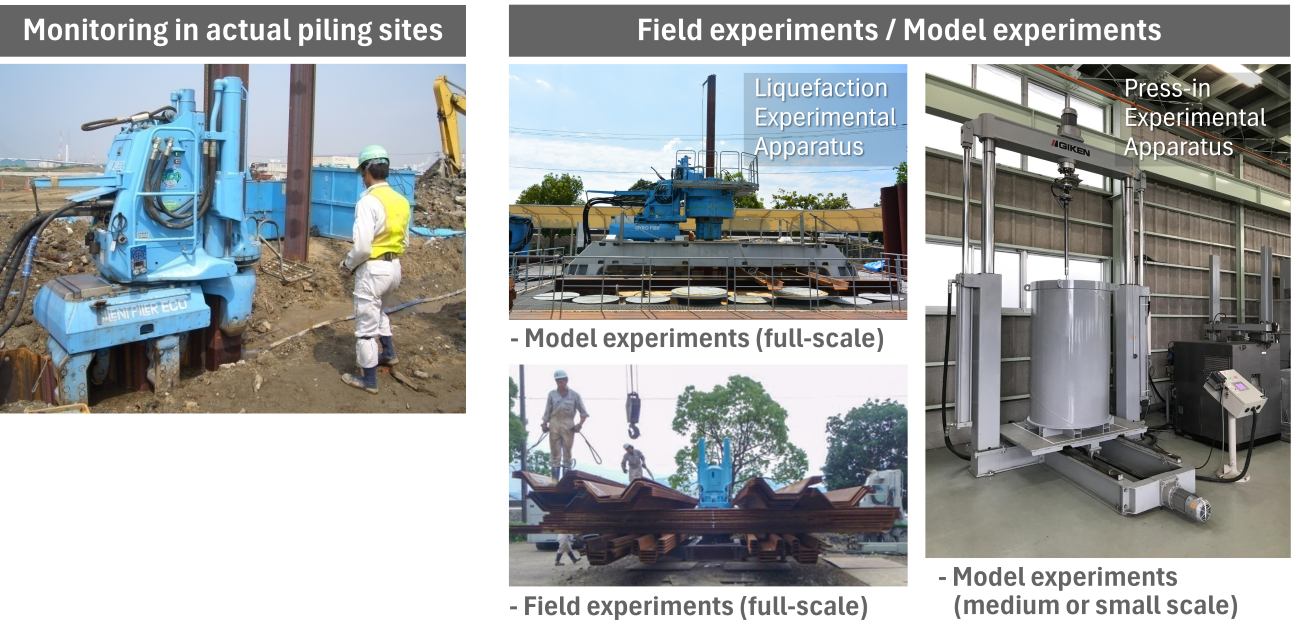
R&D activities related to “Construction Work” often begin with observation and monitoring at actual piling sites. For further investigation, full-scale experiments are conducted either in the field or using large-scale experimental facilities such as the Liquefaction Experimental Apparatus. For more controlled conditions, medium- or small-scale experimental apparatuses (e.g., the Press-in Experimental Apparatus) are employed.
R&D activities on Construction Work
R&D methods for press-in construction work
Elemental technologies to utilize press-in piling data
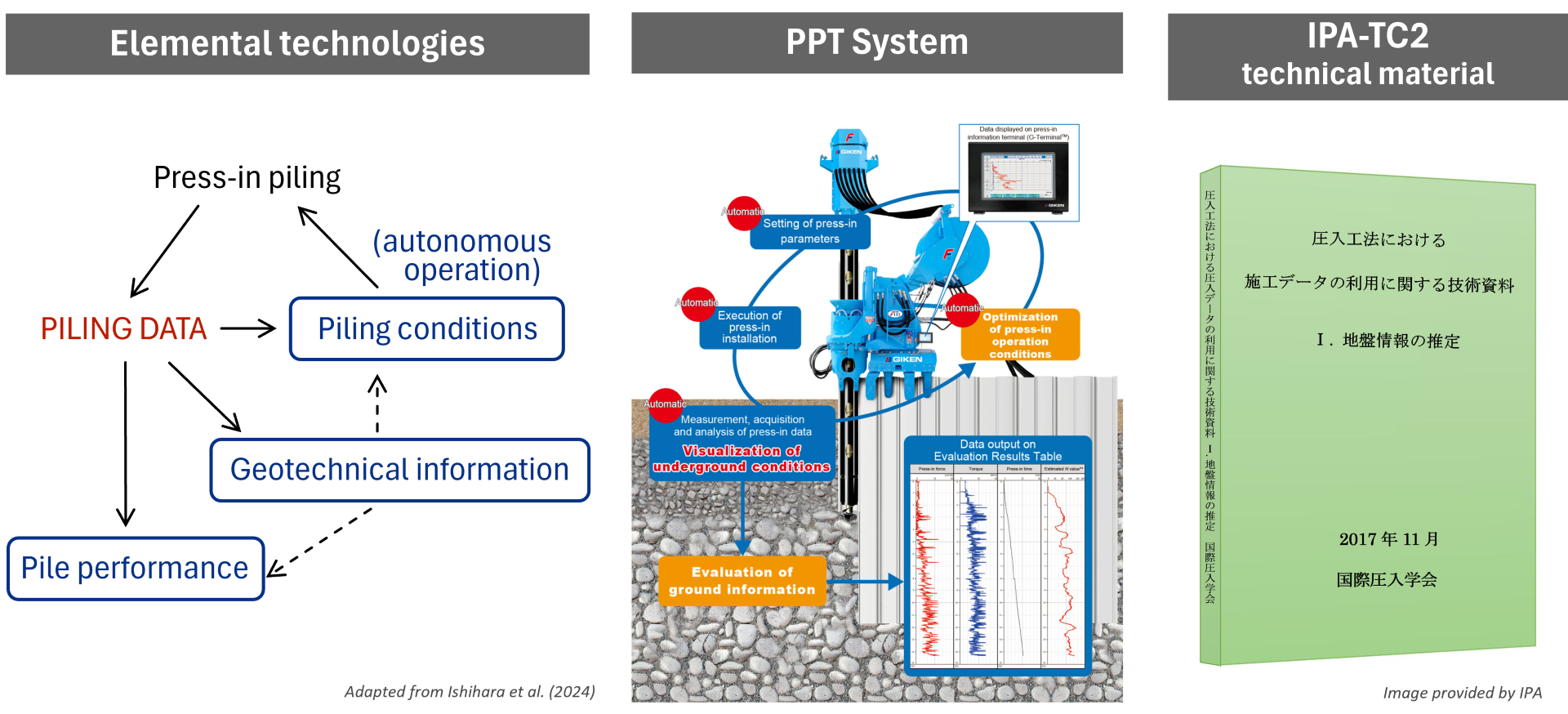
In press-in piling, data such as jacking force, torque, and penetration depth are obtained for each individual pile. These are collectively referred to as piling data. We are developing a range of elemental technologies to utilize these data (Ishihara et al., 2008), including autonomous operation of press-in piling machines (Ishihara, 2018), estimation of geotechnical information (Ishihara et al., 2015a), and evaluation of pile performance (Ishihara, 2023).
Technologies for autonomous operation and geotechnical information estimation have already been implemented in practice under the name of the PPT System (PPT System | GIKEN LTD.), and were registered in 2017 in NETIS (SK-170006-VE), a database managed by Japan’s Ministry of Land, Infrastructure, Transport and Tourism (MLIT).
The technology for geotechnical information estimation was also evaluated by IPA-TC2, leading to the publication of a technical report in 2017 (IPA, 2017; Ishihara & Kusakabe, 2021).
References
International Press-in Association (IPA). 2017. Technical Material on the Use of Piling Data in the Press-in Method: I. Estimation of Subsurface Information, 63p. (in Japanese)
Ishihara, Y., Ogawa, N., Kinoshita, S., Kitamura, A. and Tagaya, K. 2008. Study on development of the pile penetration test system based on press-in construction data. Society for Social Management Systems, CD-ROM, 10p.
Ishihara, Y., Haigh, S. K. and Bolton, M. D. 2015. Estimating base resistance and N value in rotary press-in. Soils and Foundations, Vol. 55, No. 4, pp. 788-797.
Ishihara, Y., Ogawa, N., Okada, K. and Kitamura, A. 2015a. Estimating subsurface information from data in press-in piling. Proceedings of the 5th International Workshop in Ho Chi Minh City, Press-in Engineering 2015, pp. 53-67.
Ishihara, Y. 2018. Use of press-in piling data for automatic operation of press-in machines and estimation of subsurface information. Proceedings of the First International Conference on Press-in Engineering 2018, Kochi, pp. 651-660.
Ishihara, Y. and Kusakabe, O. 2021. State of the art report on the use of press-in piling data for estimating subsurface information. Proceedings of the Second International Conference on Press-in Engineering 2021, Kochi, Japan, pp. 42-66.
Ishihara, Y. 2023. Use of press-in piling data for estimating subsurface information and pile performance. Doctoral Thesis, University of Tokyo, 421p.
Use of press-in piling data for estimating geotechnical information and pile performance
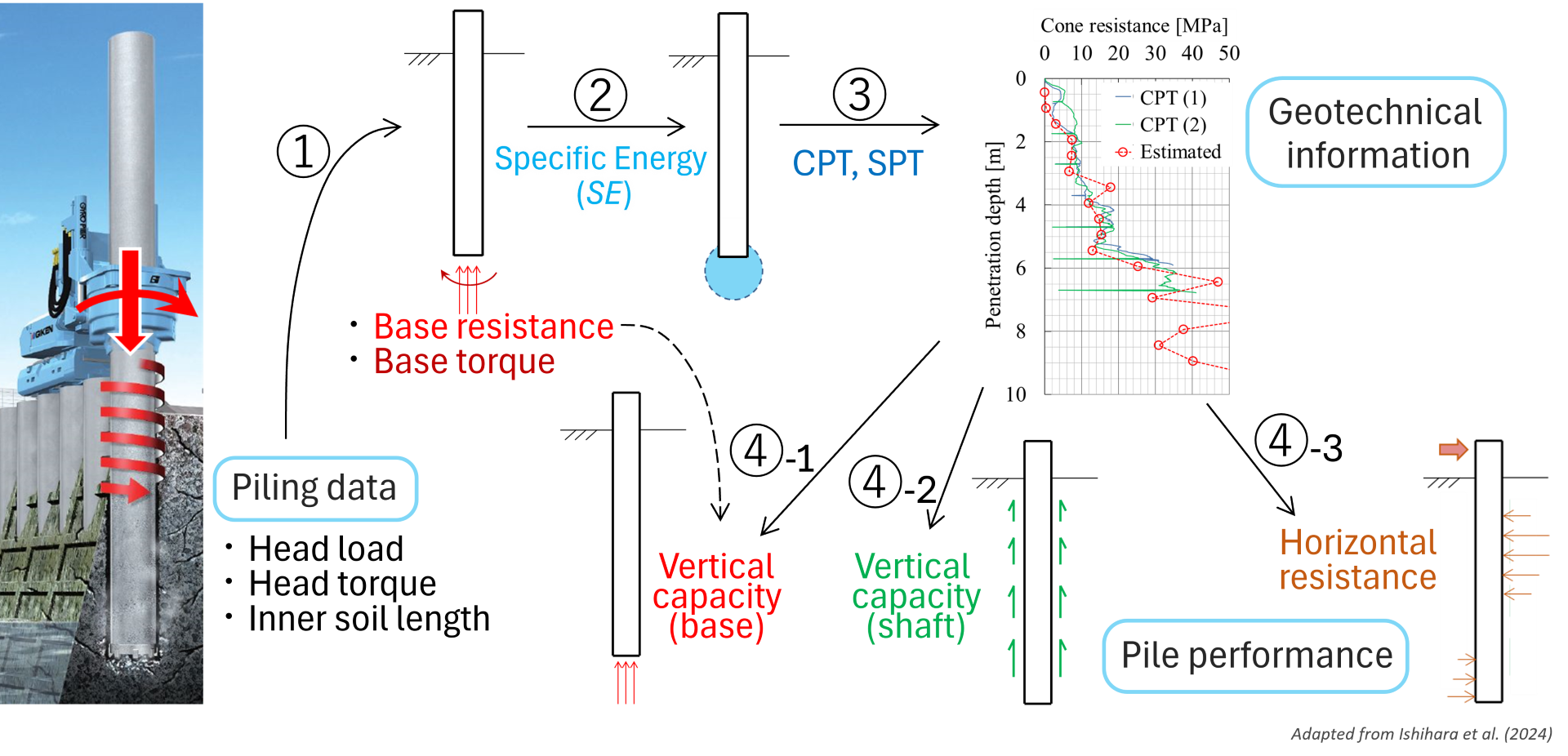
Several penetration techniques are employed in press-in piling, and methods for estimating geotechnical information and pile performance have been developed for some of these techniques. Taking RCP (Rotary Cutting Press-in) piling as an example, the estimation procedure consists of four steps (Ishihara, 2023).
In RCP piling, the head load (Q), head torque (T), and penetration depth (z) are measured by the press-in machine. In the first step, the head load (Q) and torque (T) are decomposed into base and shaft components (Qb, Qs, Tb, and Ts) without requiring any additional instrumentation on the pile. In the second step, the estimated base components (Qb and Tb) are used to calculate the Specific Energy (SE), defined as the energy required to install a unit volume into the ground, at the pile base. In the third step, the calculated SE is converted into geotechnical parameters such as qc (cone resistance of CPT: Cone Penetration Test) or the N-value of SPT (Standard Penetration Test). Finally, the estimated geotechnical parameters (qc or N) are used as inputs to calculation formulas for vertical bearing capacity and horizontal resistance. For vertical bearing capacity, specialized methods have been developed for RCP piles, addressing both base resistance (Ishihara et al., 2020) and shaft resistance (Ishihara et al., 2025).
References
Ishihara, Y. 2023. Use of press-in piling data for estimating subsurface information and pile performance. Doctoral Thesis, University of Tokyo, 421p.
Ishihara, Y., Haigh, S. and Koseki, J. 2020. Assessment of base capacity of open-ended tubular piles installed by the Rotary Cutting Press-in Method. Soils and Foundations, Vol. 60, Issue 5, pp. 1189-1201.
Ishihara, Y., Okada, K. and Koseki, J. 2025. Correlating SPT results with shaft capacity of pipe piles installed by the Rotary Cutting Press-in Method. Proceedings of DFI India 2025: Deep Foundation Technologies for Infrastructure Development in India, Surat, Gujarat, pp. 618-627.
Application of press-in piling data to rational construction process
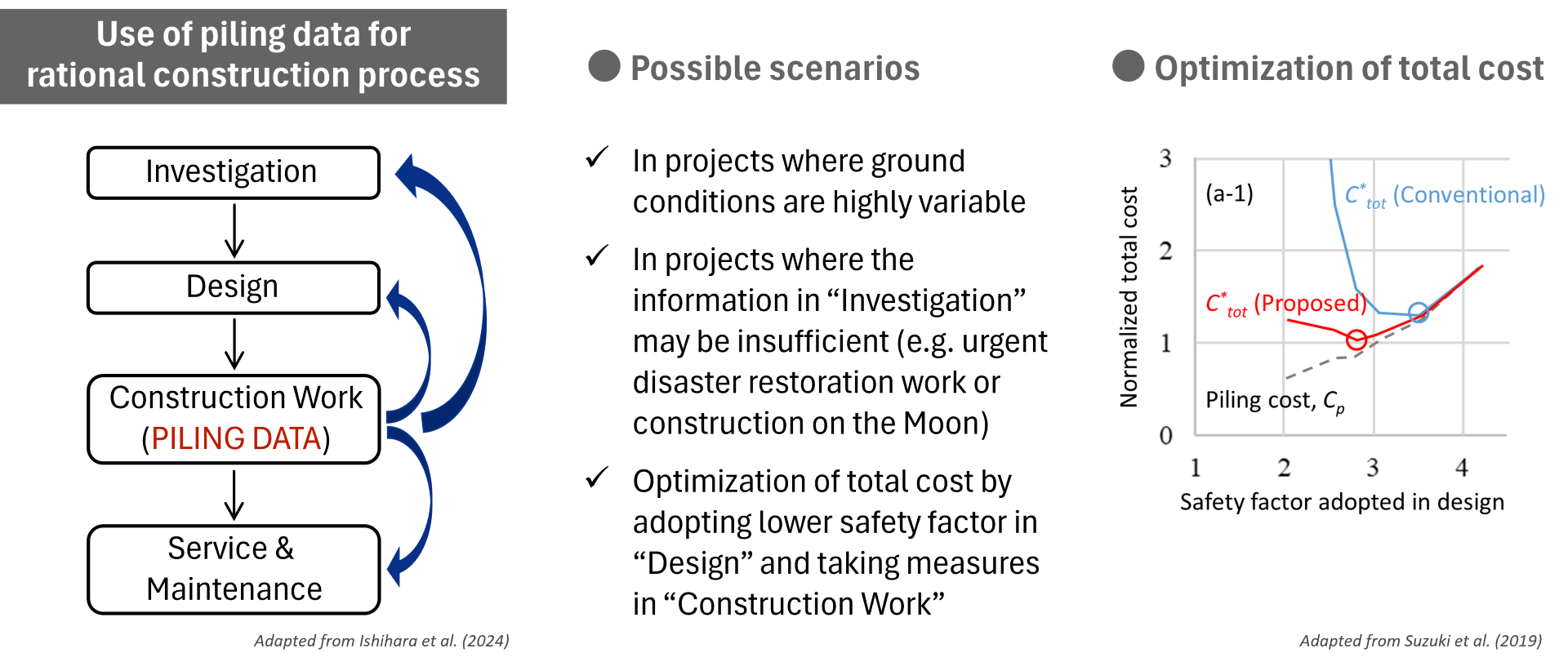
Construction projects have traditionally progressed in a one-directional sequence: “Investigation,” “Design,” “Construction Work” and “Service and Maintenance.” However, in certain cases, this process can be rationalized by utilizing information obtained during the "Construction Work" phase to update and refine earlier phases such as "Investigation" and "Design".
For example, in projects located near mountains or rivers, geotechnical conditions can be highly variable. Bearing strata may be inclined, and large boulders or cobbles may be scattered throughout the ground. Such variability is often difficult to fully capture during the "Investigation" phase, leading to the discovery of “unexpected ground conditions” during construction. When properly interpreted, information obtained during "Construction Work" can serve as objective evidence to support decisions regarding design modifications or changes in piling methods or penetration techniques.
In other cases—such as emergency disaster recovery projects or construction on the Moon (Ishihara et al., 2024)—it may be difficult to conduct sufficient site investigation in advance. Under such conditions, information obtained during "Construction Work" can play a critical role in supplementing geotechnical data.
Furthermore, more proactive use of "Construction Work" phase information can enable optimization of overall project costs. For instance, adopting a lower safety factor during the "Design" phase may be justified if its validity is verified during "Construction Work", with additional measures implemented when necessary. This approach can be particularly effective for projects with high importance and potentially significant damage costs (Suzuki & Ishihara, 2019).
References
Ishihara, Y., Eguchi, M., Mori, A. and Toda, Y. 2024. Use of press-in piling data for construction on the Moon: estimating subsurface information and pile capacity. Proceedings of the 3rd International Conference on Press-in Engineering 2024, Singapore, pp. 131-140.
Suzuki, N. and Ishihara, Y. 2019. Case study on the application of press-in piling data to design and construction of pile foundations for reducing the expected total cost. International Conference on Case Histories & Soil Properties, Singapore, 16p.
Application of press-in piling data to Digital Twin of construction

BEEYONDERS is a project funded by the European Union (EU) that aims to enhance construction productivity through the use of digital twins. We contributed to this project as a Supporter, by providing our technology for estimating the cone resistance from CPT (Cone Penetration Test) based on data obtained during RCP (Rotary Cutting Press-in) piling.
Further information is available on the project’s website (see “Case Studies – BEEYONDERS”).
R&D activities on Structures
Methods for evaluating the performance of pressed-in piles and sheet piles
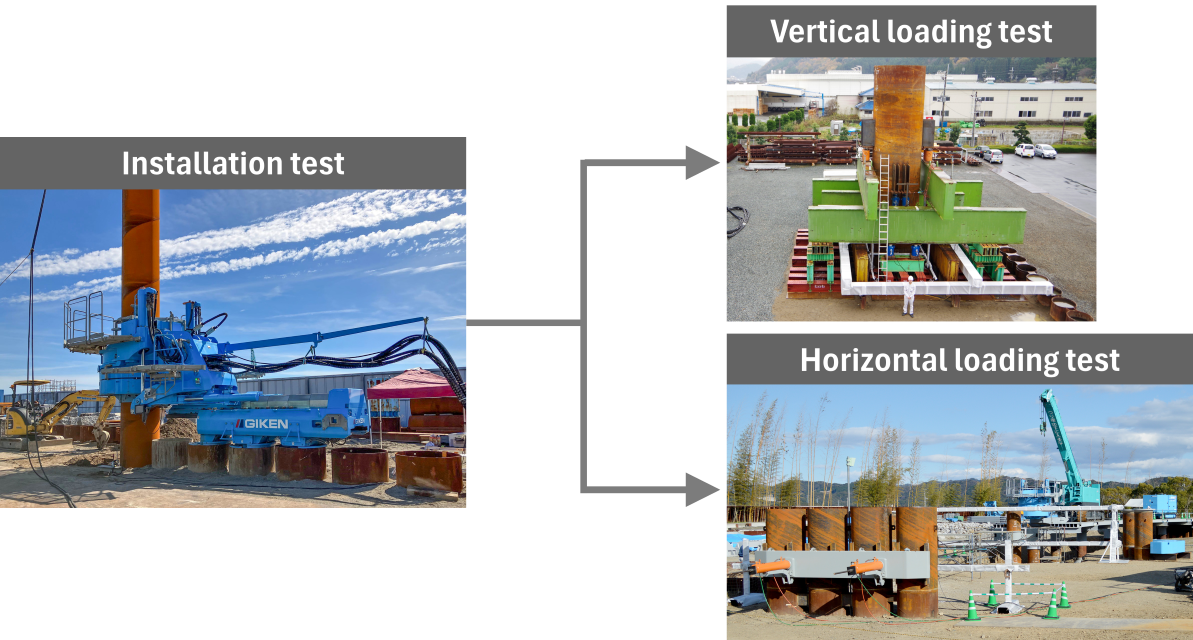
The fundamental and essential aspect of R&D activities related to structures is the investigation of the performance of individual piles, including sheet piles. Since pile performance is influenced by both ground conditions and installation processes, these investigations must encompass a wide range of ground conditions as well as various penetration techniques used in press-in piling. These include Standard Press-in (SP), Press-in with Water Jet (PWJ), Press-in with Auger (PA, or Hard Ground Press-in Method), and Rotary Cutting Press-in (RCP, or Gyropress Method™).
Such investigations are typically conducted through a combination of installation tests and loading tests. In an installation test, a test pile is installed using a specified penetration technique under controlled press-in conditions. After a designated period, a loading test is carried out on the installed pile. Depending on the objectives and budget of the study, either a static or a rapid loading test is employed.
Performance of SP piles and sheet piles
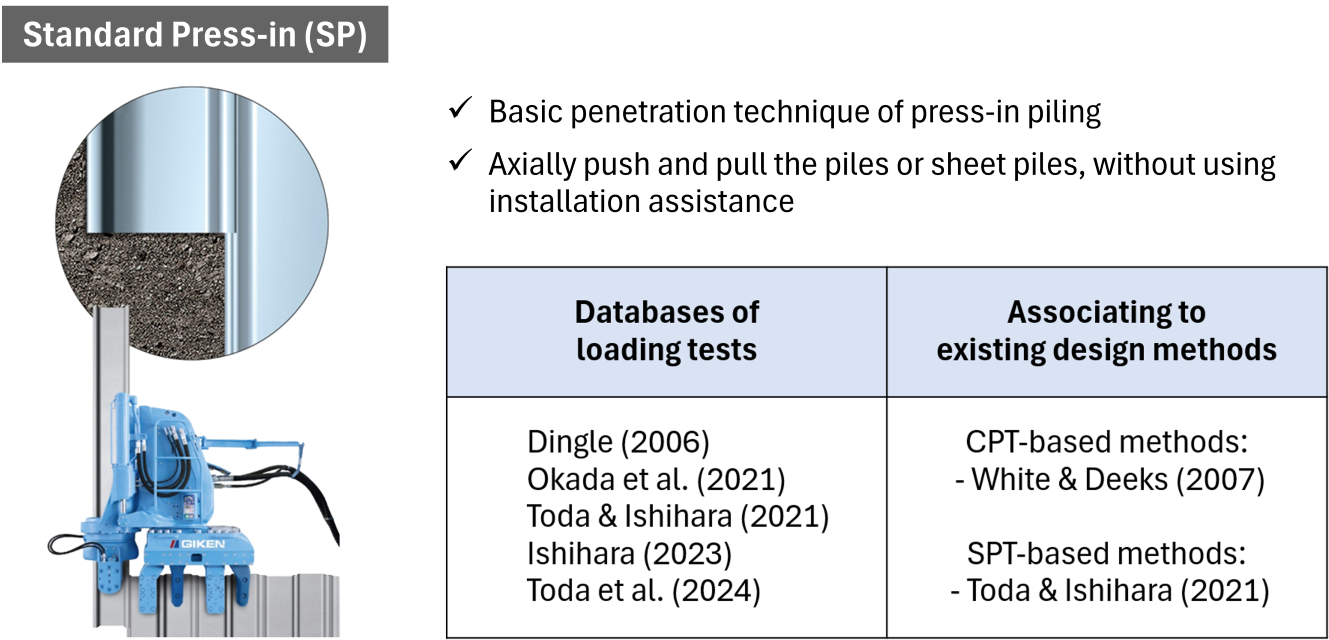
Standard Press-in (SP) is the fundamental penetration technique in the press-in method, in which piles or sheet piles are installed using axial loading. This method does not employ any auxiliary installation aids such as water jets or augers.
Extensive databases of loading tests have been compiled in studies by Dingle (2006), Okada et al. (2021), Toda & Ishihara (2021), Ishihara (2023), and Toda et al. (2024). These databases have been utilized to correlate the performance of SP piles with existing design methodologies, as demonstrated by White & Deeks (2007) and Toda & Ishihara (2021).
References
Dingle, H. 2006. The testing and analysis of jacked foundation piles. M.Eng. Project Report, University of Cambridge Department of Engineering, 50p.
Ishihara, Y. 2023. Use of press-in piling data for estimating subsurface information and pile performance. Doctoral Thesis, University of Tokyo, 421p.
Okada, K., Inomata, K. and Ishihara, Y. 2021. Results of static vertical load tests on tubular piles installed by Standard Press-in and Rotary Cutting Press-in. Proceedings of the Second International Conference on Press-in Engineering 2021, Kochi, Japan, pp. 124-130.
Toda, K. and Ishihara, Y. 2021. An investigation into vertical capacity of steel sheet piles installed by the Standard Press-in method. Proceedings of the Second International Conference on Press-in Engineering 2021, Kochi, Japan, pp. 177-184.
Toda, Y., Eguchi, M., Mori, A. and Ishihara, Y. 2024. Vertical load tests on zero sheet pile pressed-in into alluvial soft ground. Proceedings of the 3rd International Conference on Press-in Engineering 2024, Singapore, pp. 409-416.
White, D. J. and Deeks, A. D. 2007. Recent research into the behaviour of jacked foundation piles. Advances in Deep Foundations, pp. 3-26.
Performance of PA sheet piles
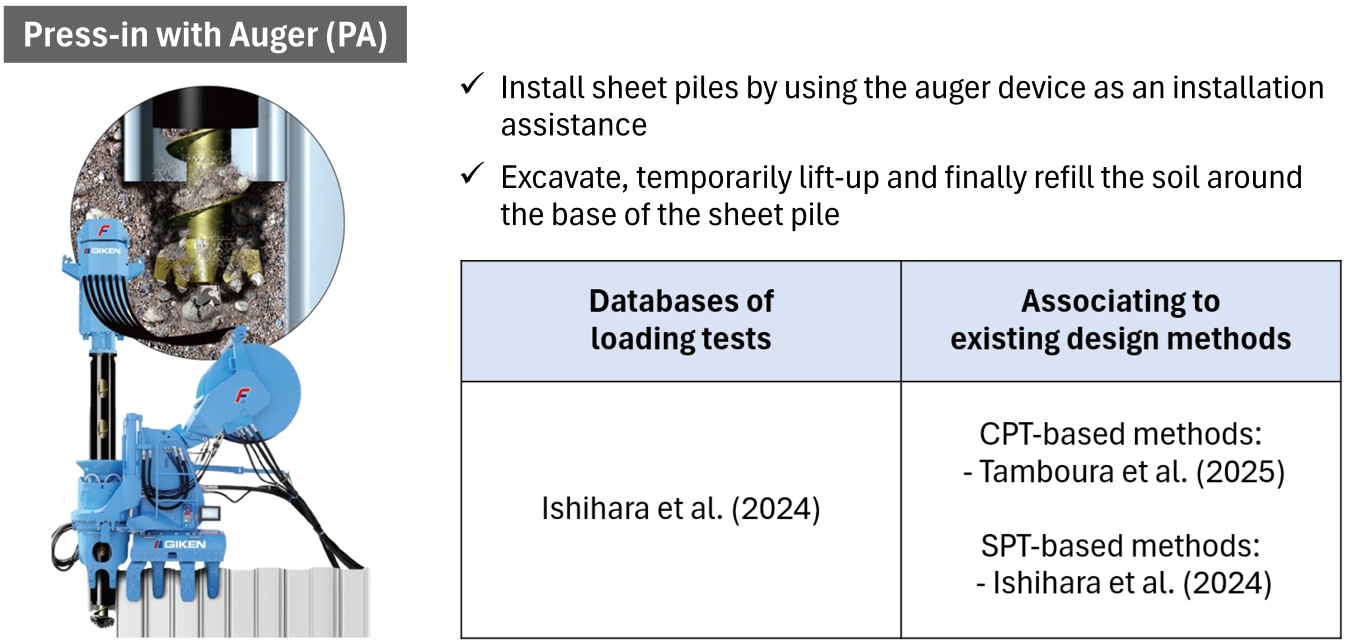
Press-in with Auger (PA), also known as the Hard Ground Press-in Method, is a penetration technique within the press-in method in which sheet piles are installed using an auger. In this method, the soil around the base of the sheet pile is excavated, temporarily lifted toward the ground surface, and subsequently refilled.
A database of loading tests has been compiled by Ishihara et al. (2024a). These results have been used to correlate the performance of PA sheet piles with existing design methods, including an SPT-based approach (Ishihara et al., 2024a) and a CPT-based approach (Tamboura et al., 2025).
References
Ishihara, Y., Okada, K., Eguchi, M., Mori, A. and Miyanohara, T. 2024a. Field tests on vertical and horizontal resistance of steel sheet piles installed by the Press-in with Auger. Proceedings of the 18th European Conference on Soil Mechanics and Geotechnical Engineering, 6p.
Tamboura, H. H., Ishihara, Y., Eguchi, M. and Mori, A. 2025. CPT-based analysis on vertical and lateral capacity of steel sheet piles installed by the Press-in with Auger. Proceedings of the International Conference on Deep Foundations and Ground Improvement, Geotechnics Reimagined, DFI-EFFC, pp. 947-956.
Performance of RCP piles
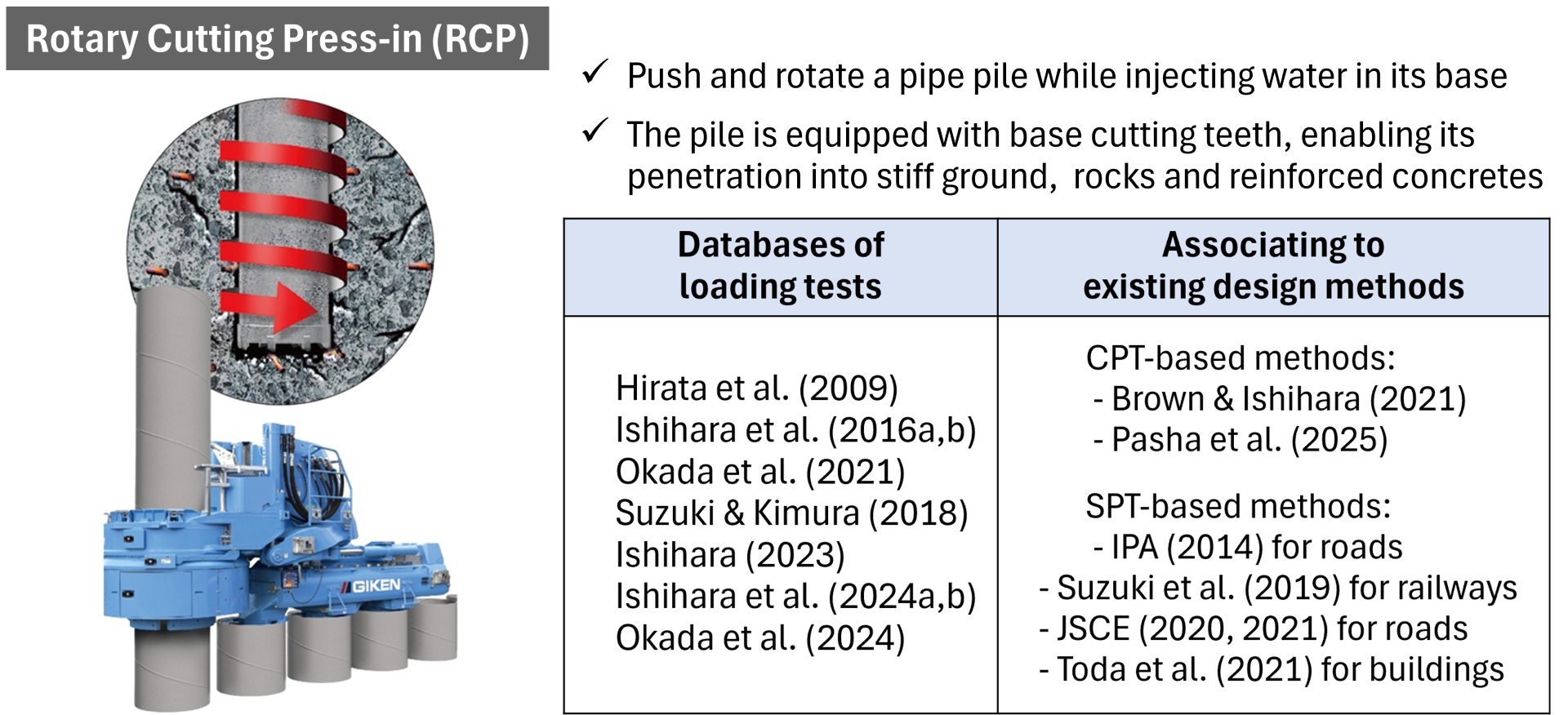
Rotary Cutting Press-in (RCP), also known as the Gyropress Method™, is a penetration technique within the press-in method in which pipe piles are installed using both vertical and rotational loading. Equipped with cutting teeth at the pile tip, this method enables penetration through stiff ground, rock, and even reinforced concrete.
Extensive databases of loading tests have been compiled in studies by Hirata et al. (2009), Ishihara et al. (2016a, b), Okada et al. (2021), Suzuki & Kimura (2018), Ishihara (2023), Ishihara et al. (2024a, b), and Okada et al. (2024). These databases have been used to correlate the performance of RCP piles with existing design methodologies, as demonstrated by Brown & Ishihara (2021), Pasha et al. (2025), IPA (2014), Suzuki et al. (2019), JSCE (2020, 2021), and Toda et al. (2021b). Among these, the JSCE Technical Assessment Reports (JSCE, 2020; JSCE, 2021) are currently widely used in practice, particularly in Japan.
References
Brown, M. and Ishihara, Y. 2021. Predicting the capacity of push and rotate piles using offshore design techniques and CPT tests. Proceedings of the Second International Conference on Press-in Engineering 2021, Kochi, pp. 185-193.
Hirata, H., Suzuki, T., Matsui, N. and Yasuoka, H. 2009. Bearing capacity performance of rotary press-in method (Gyropress Method): part 1 (vertical capacity). Proceedings of the 65th JSCE (Japanese Society of Civil Engineers) Annual Meeting, pp. 41-42. (in Japanese)
International Press-in Association (IPA). 2014. Design and Construction Manual for Earth Retaining Walls with Tubular Piles Installed by Gyropress (Rotary Cutting Press-in) Method, 143p. (in Japanese)
Ishihara, Y., Ogawa, N., Okada, K., Inomata, K., Yamane, T. and Kitamura, A. 2016a. Model test and full-scale field test on vertical and horizontal resistance of hatted tubular pile. Proceedings of the Third International Conference Geotec Hanoi 2016 - Geotechnics for Sustainable Infrastructure development, pp. 131-139.
Ishihara, Y., Okada, K., Yokotobi, T. and Kitamura, A. 2016b. Pull-out resistance of a large diameter steel tubular pile installed by Rotary Cutting Press-in. Proceedings of the Third International Conference Geotec Hanoi 2016 - Geotechnics for Sustainable Infrastructure development, pp. 141-147.
Ishihara, Y. 2023. Use of press-in piling data for estimating subsurface information and pile performance. Doctoral Thesis, University of Tokyo, 421p.
Ishihara, Y., Eguchi, M., Mori, A. and Toda, Y. 2024a. Use of press-in piling data for construction on the Moon: estimating subsurface information and pile capacity. Proceedings of the 3rd International Conference on Press-in Engineering 2024, Singapore, pp. 131-140.
Ishihara, Y., Okada, K., Toda, Y. and Kitano, Y. 2024b. Case history of installation and static vertical load testing on piles executed by the Rotary Cutting Press-in in Amsterdam. Proceedings of the 18th European Conference on Soil Mechanics and Geotechnical Engineering, 7p.
Japan Society for Civil Engineers (JSCE). 2020. Report of technology assessment of design and construction method for Rotary Cutting Press-in (Gyropress) Method. Technology Promotion Library, No. 25, 113p. (in Japanese)
Japan Society for Civil Engineers (JSCE). 2021. Technical Evaluation for the Design and Construction Method for Rotary Press-in Piling Method (Gyropress Method), Report, Certificate No. 25.
Okada, K., Inomata, K. and Ishihara, Y. 2021. Results of static vertical load tests on tubular piles installed by Standard Press-in and Rotary Cutting Press-in. Proceedings of the Second International Conference on Press-in Engineering 2021, Kochi, Japan, pp. 124-130.
Okada, K., Murata, T., Mori, A., Toda, Y. and Ishihara, Y. 2024. Development of rapid load test device and its applicability to piles installed by Rotary Cutting Press-in. Proceedings of the 3rd International Conference on Press-in Engineering 2024, Singapore, pp. 124-130.
Pasha, S. M. K., Ishihara, Y., Eguchi, M. and Toda, Y. 2025. CPT based design method for horizontal capacity of piles installed by the Rotary Cutting Press-in Method. Proceedings of the International Conference on Deep Foundations and Ground Improvement, Geotechnics Reimagined, DFI-EFFC, pp. 736-746.
Suzuki, N., Kimura, Y., Sanagawa, T. and Nishioka, H. 2019. Modeling of vertical bearing capacity of rotary Press-in pile used for a railway structure. Journal of Railway Engineering Research 23, pp. 217-222. (in Japanese)
Suzuki, N. and Kimura, Y. 2018. Study on the horizontal bearing performance of steel tubular piles installed by the Gyropress Method and the Press-in Method assisted with water jetting. Proceedings of the First International Conference on Press-in Engineering 2018, Kochi, pp. 125-132.
Toda, K., Ishihara, Y. and Suzuki, N. 2021b. Comparison of SPT-based design methods for vertical capacity of piles installed by Rotary Cutting Press-in. Proceedings of the Second International Conference on Press-in Engineering 2021, Kochi, Japan, pp. 169-176.
Methods for evaluating the performance of structures
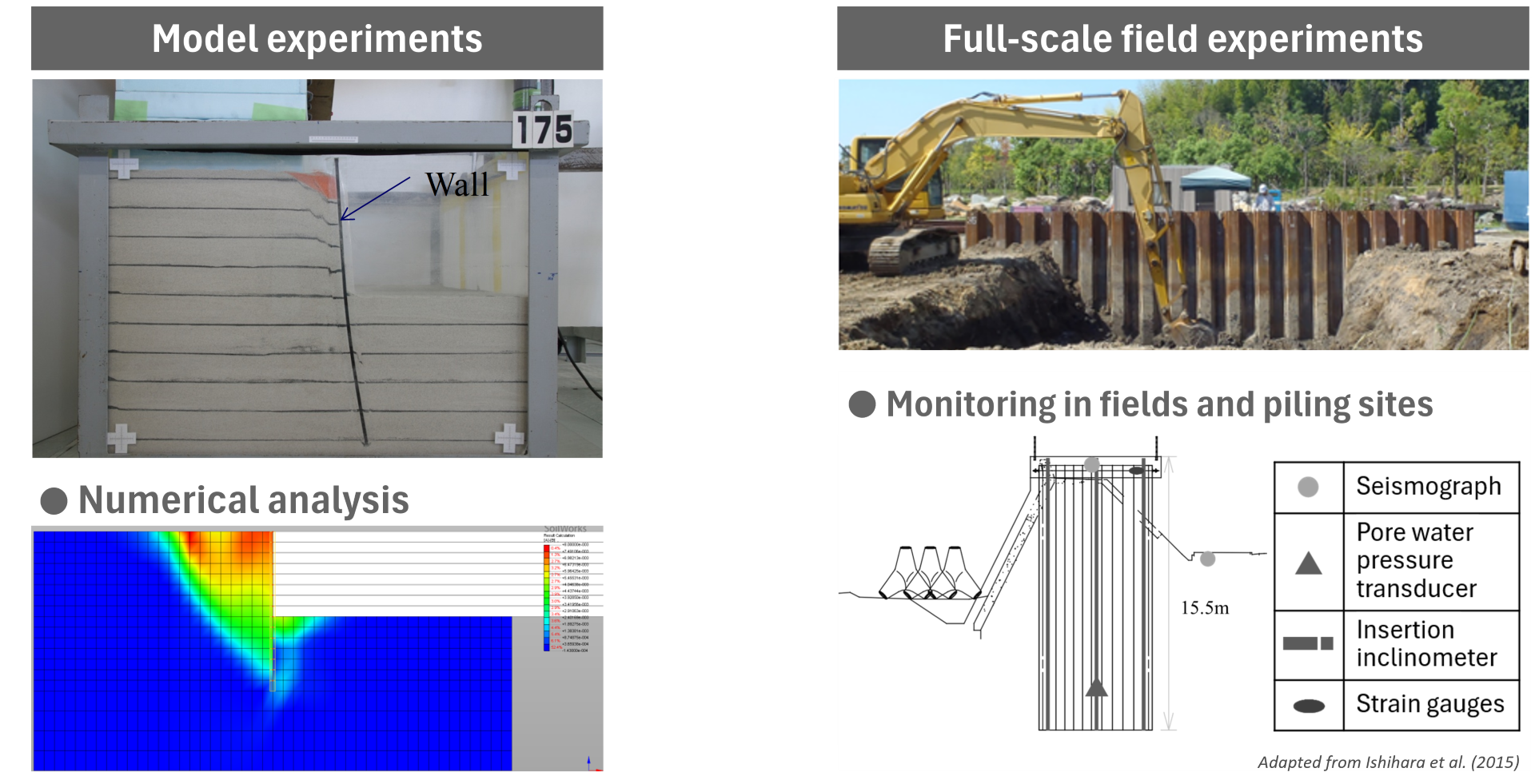
R&D activities related to “Structures” often begin with model experiments and numerical analyses, and may progress to large-scale or full-scale experiments depending on the expected effectiveness of the structure. In addition, monitoring of actual structures is sometimes conducted to verify their performance and to support future improvements.
Performance of hatted tubular pile for “Implant Bell Cap Bridge”
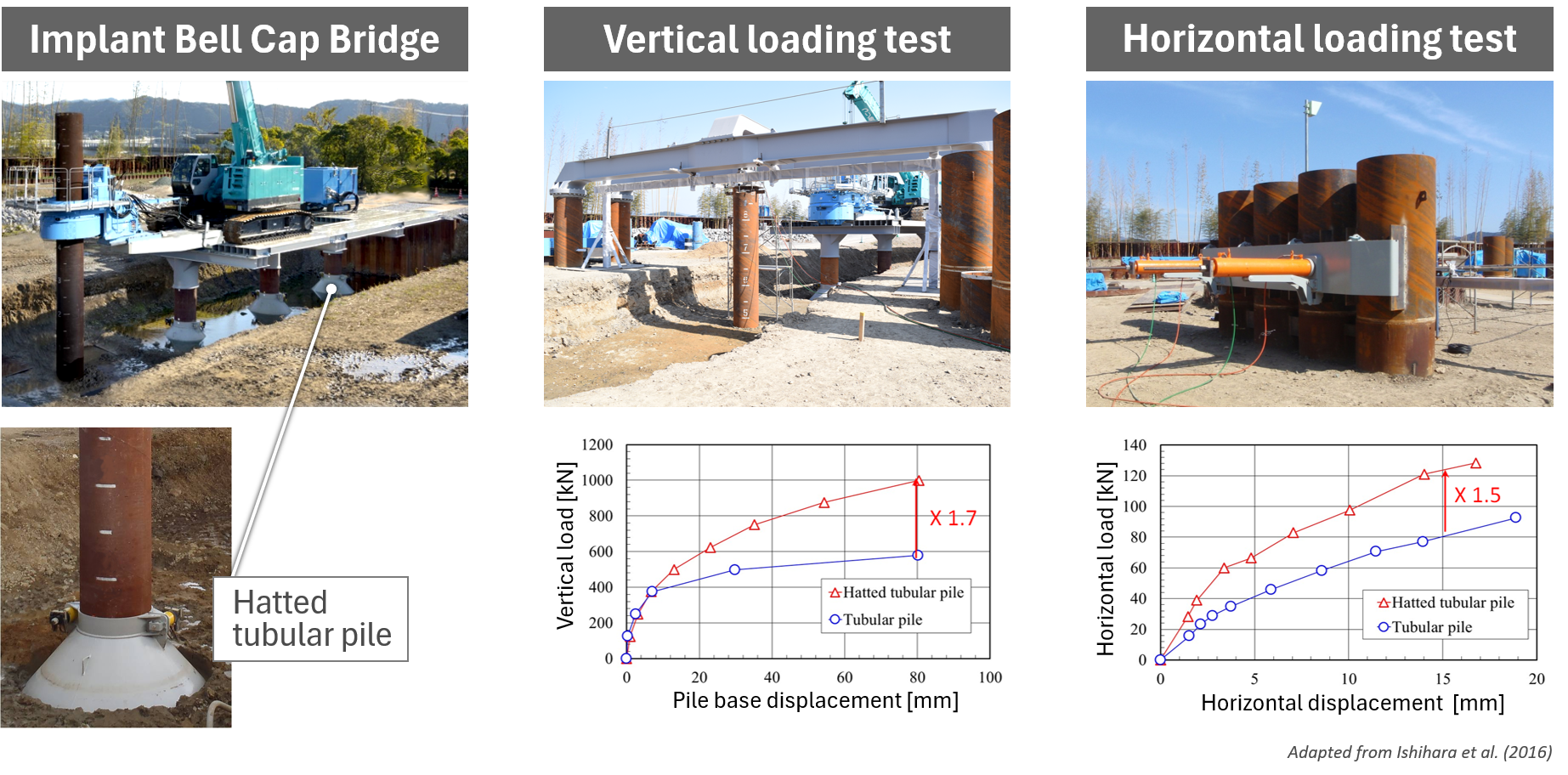
The “Implant Bell Cap Bridge” is a bridge system that utilizes hatted tubular piles as pier piles, supporting the superstructure by placing deck panels on T-shaped beams installed on the pier piles. A hatted tubular pile is composed of an open-ended steel tubular pile and a bell-shaped cap, which are rigidly connected near the ground surface level. Owing to a press-in piling system specifically developed for this bridge, construction can be carried out rapidly within a limited working space. In addition, the bridge can be easily dismantled by reversing the construction procedure.
The vertical and horizontal resistance of the hatted tubular pile was investigated through both 1-g model experiments and full-scale field experiments (Ishihara et al., 2016). Compared with conventional piles, the initial vertical stiffness - for head displacement of smaller than 1/100 of the pile diameter - was comparable, while the ultimate vertical capacity was approximately 1.7 times greater.
In terms of horizontal resistance, the hatted tubular pile exhibited consistently higher performance from the initial loading stage, reaching approximately 1.5 times the resistance of a conventional pile when the horizontal displacement at ground level was 15 mm.
Reference
Ishihara, Y., Ogawa, N., Okada, K., Inomata, K., Yamane, T. and Kitamura, A. 2016. Model test and full-scale field test on vertical and horizontal resistance of hatted tubular pile. Proceedings of the Third International Conference Geotec Hanoi 2016 - Geotechnics for Sustainable Infrastructure development, pp. 131-139.
Performance of breakwater with rows of pipe piles ("Implant Tsunami Mitigation Breakwater")
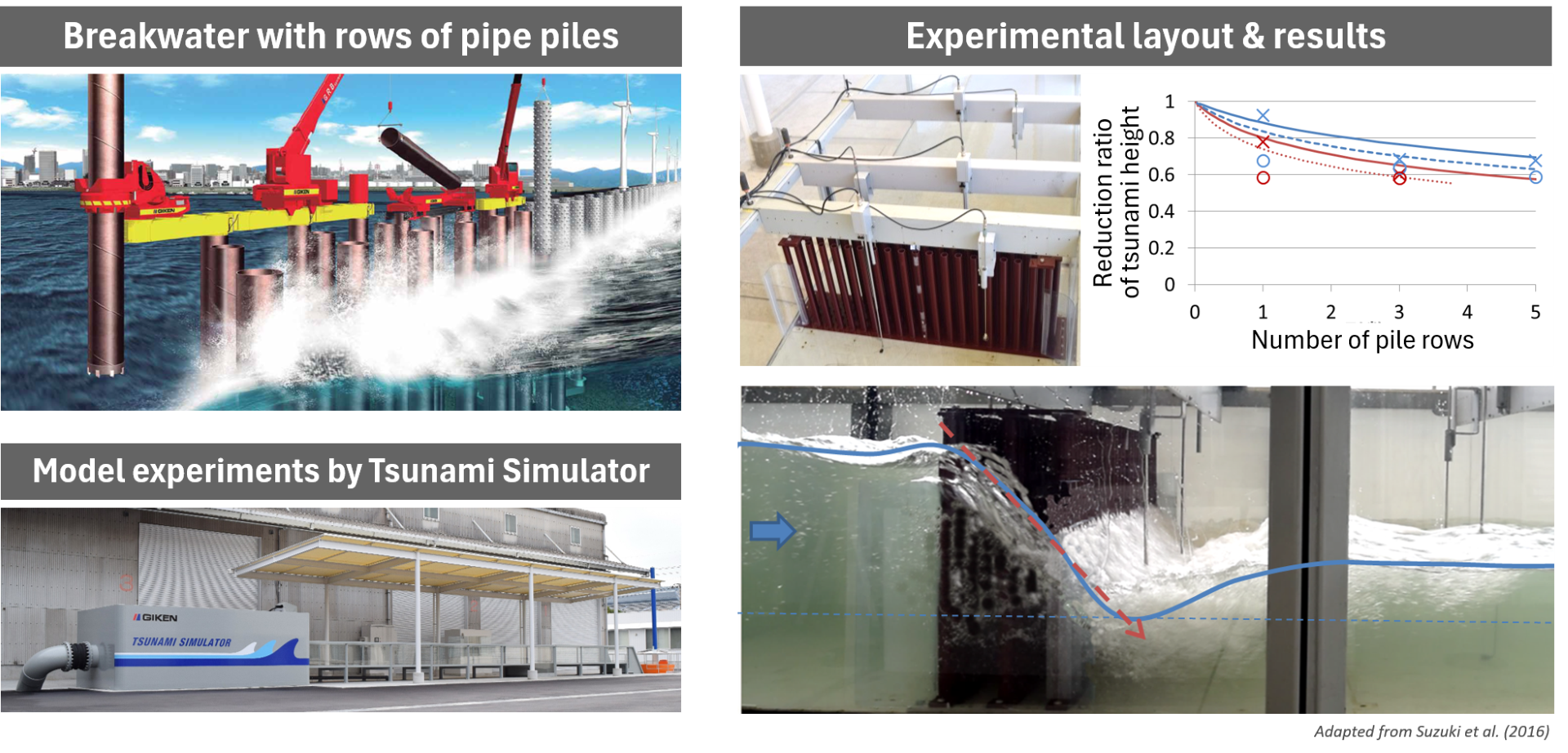
The “Implant Tsunami Mitigation Breakwater” (Implant Breakwater) is an offshore structure composed of rows of pipe piles, primarily designed to mitigate tsunami impacts. Each pile is embedded into the ground with sufficient depth to resist tsunami-induced loads.
Suzuki et al. (2016) conducted 1-g model experiments to better understand the effects of pile spacing, the number of pile rows, and the relative tsunami height. The results showed that tsunami transmissivity increases with the spacing between piles. In particular, increasing the number of pile rows reduces the tsunami load acting on each row, with smaller loads observed on the downstream rows.
Furthermore, in the evaluation of tsunami forces, it was confirmed that the drag coefficient can be applied to multiple rows of piles, while the revised Tanimoto Formula with a reduction coefficient is applicable for a single row.
Reference
Suzuki, N., Ishihara, Y. and Isobe, M. 2016. Experimental study on tsunami mitigation effect of breakwater with arrays of steel tubular piles. Journal of Social Safety Science, No. 29, 2016.11, pp. 7-14. (in Japanese)
Performance of hybrid-type pipe pile wall for tsunami mitigation (“Implant Barrier”)
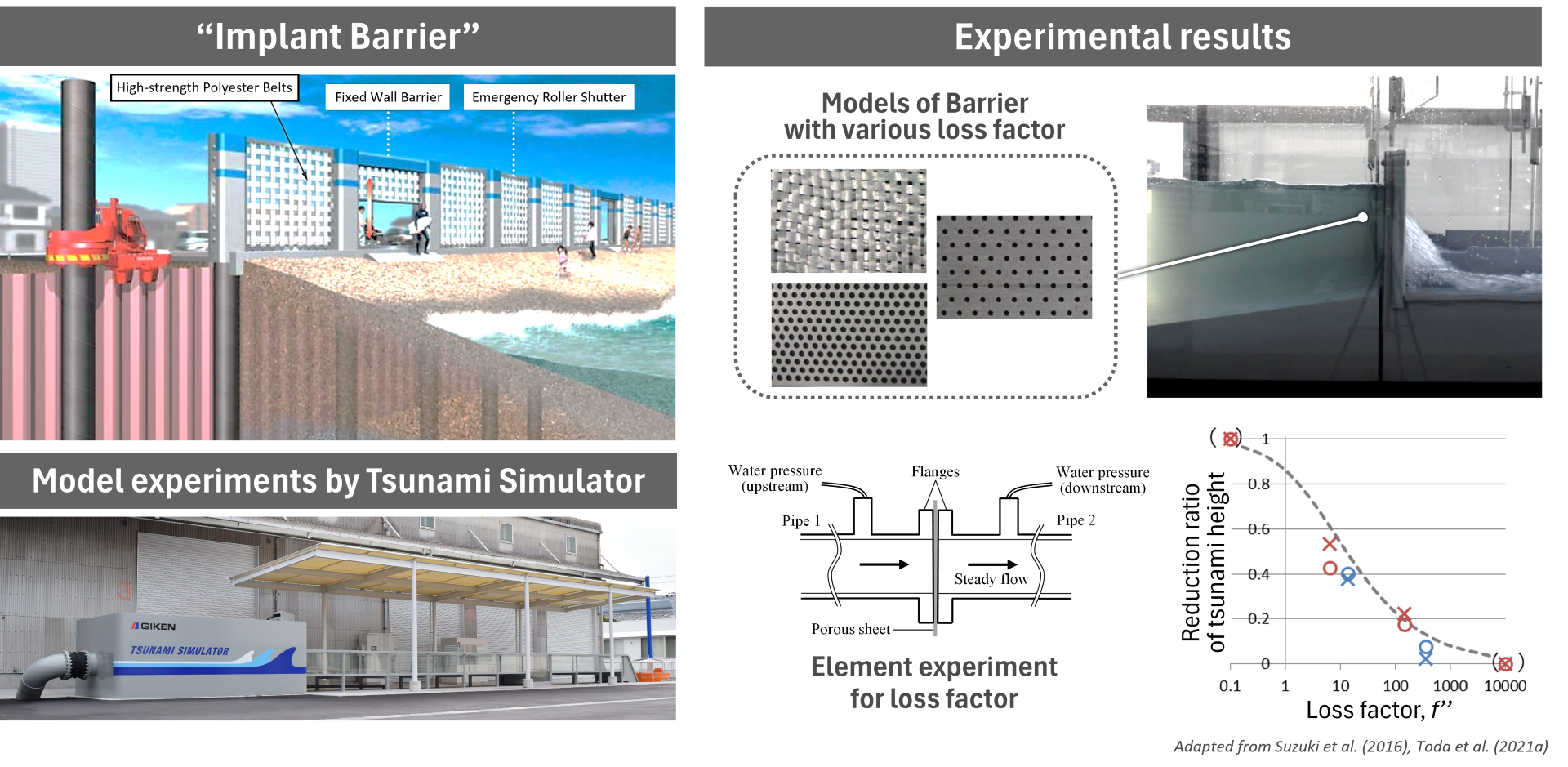
The “Implant Barrier” is a protective structure designed for disaster prevention and mitigation, primarily targeting tsunami hazards. It consists mainly of strut members and wall members. The strut members are typically pressed-in steel pipe piles arranged at specified intervals, while the wall members - made of concrete, metal, or fiber - are attached to these struts.
When porous fiber sheets are used as wall members, reduction of tsunami load and wave height is achieved through energy dissipation as the flow passes through the barrier. Suzuki et al. (2016) proposed a theoretical model incorporating a “loss factor” to represent this mechanism and confirmed through model experiments that the reduction in tsunami height can be expressed as a function of this factor. They also introduced element-scale experiments to quantify the loss factor of the wall materials.
Toda et al. (2021a) further enhanced the theoretical framework proposed by Suzuki et al. (2016) to account for overtopping conditions, where tsunami waves flow over the barrier. This was achieved by introducing the concepts of “equivalent aperture ratio” and “equivalent loss factor.” Comparisons with experimental results showed that the updated model provides reasonable estimates of water depth behind the barrier, although it tends to underestimate the water depth in front of the barrier and the tsunami load acting on it. In addition, the influence of wall member shape (flat or flexural) was investigated, revealing that flexural configurations offer slightly improved performance.
References
Suzuki, N., Ishihara, Y. and Isobe, M. 2016. Experimental study on influence of porosity and material of pile-type porous tide barrier on its tsunami mitigation effect. Journal of Japan Society of Civil Engineers, Ser. B3 (Ocean Engineering), Vol. 72, No. 2, pp. I-491-I-496. (in Japanese)
Toda, K., Mori, A., Ishihara, Y. and Suzuki, N. 2021a. Experimental study on tsunami mitigation effect of pile-type porous tide barrier. Proceedings of the Second International Conference on Press-in Engineering 2021, Kochi, Japan, pp. 444-453.
Performance of rectangular sheet pile wall (“Confined Ground Seismic Damper”)
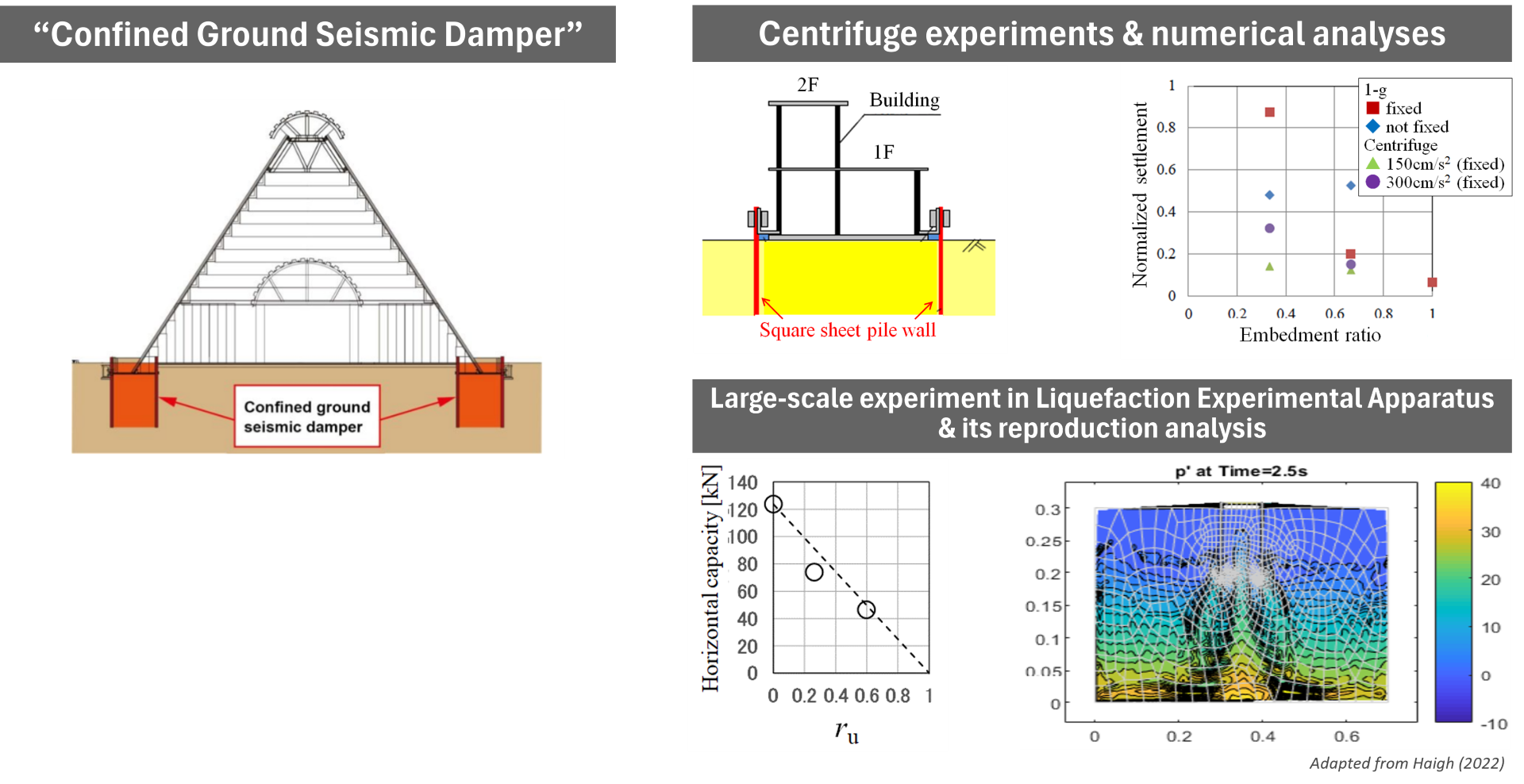
The “Confined Ground Seismic Damper” consists of a closed-form rectangular pressed-in sheet pile wall and the ground confined within it. It functions either as a foundation system or as a means of reinforcing an existing foundation.
Its effectiveness in reducing settlement and inclination of structures (e.g., residential houses) due to liquefaction was investigated by Kato et al. (2014) through 1-g model experiments, centrifuge experiments and numerical analyses. The results showed that both settlement and inclination can be reduced even when the embedment ratio (defined as the ratio of embedment depth to the thickness of the liquefiable layer) is less than one - that is, even when the sheet pile wall does not reach a non-liquefiable layer. Greater reductions were achieved when the embedment ratio exceeded one.
Toda et al. (2022, 2023) conducted a series of large-scale model experiments using the Liquefaction Experimental Apparatus to investigate the vertical and horizontal resistance of a slab supported by a square sheet pile wall under various liquefaction conditions, characterized by the excess pore water pressure ratio (ru). Both vertical and horizontal resistance were found to decrease with increasing ru, with a roughly linear relationship observed.
Haigh (2022) reproduced the experiments of Toda et al. (2022, 2023) through centrifuge model experiments and numerical analyses. The study indicated the formation of a column of non-liquefied soil within and beneath the sheet pile wall, which may explain why the structure retains a certain level of resistance even under liquefied ground conditions.
References
Haigh, A. 2022. Performance of Implant structures. M.Eng. Thesis, University of Cambridge, 52p.
Kato, I., Hamada, M., Higuchi, S., Kimura, H. and Kimura, Y. 2014. Effectiveness of the sheet pile wall against house subsidence and tilting induced by liquefaction. Journal of Japan Association for Earthquake Engineering, Vol. 14, No. 4, pp. 4_35-4_49. (in Japanese)
Toda, K., Ishihara, Y., Eguchi, M. and Mori, A. 2022. Experimental study on a foundation reinforced by square sheet pile wall. Japan Society of Civil Engineers 2021 Annual Meeting, 2p. (in Japanese)
Toda, K., Ishihara, Y., Eguchi, M. and Mori, A. 2023. Horizontal resistance of a slab reinforced by square sheet pile wall in a liquefied ground. Japan Society of Civil Engineers 2023 Annual Meeting, 2p. (in Japanese)
Performance of sheet pile retaining wall ("Preload Retaining Wall")
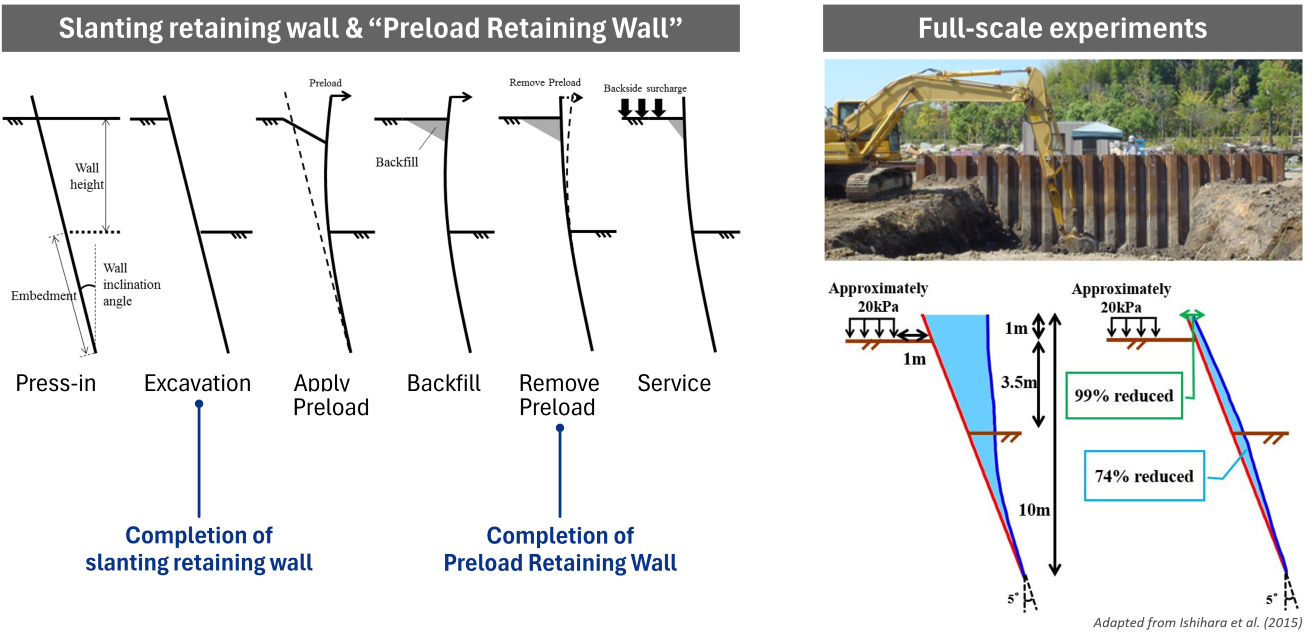
The “Preload Retaining Wall” is a sheet pile wall characterized by both an inclination angle and a curved (bow-shaped) configuration. Its construction procedure consists of the following steps: (1) installing sheet piles at a specified inclination angle, (2) excavating one side of the wall, (3) applying a horizontal load (preload) to the wall, (4) backfilling the space behind the wall, and (5) removing the preload.
Gao (2014) and Ishihara et al. (2015) reported results from 1-g model experiments and full-scale field experiments comparing the deformation behavior of this wall with that of a conventional slanting retaining wall under surcharge loading. When subjected to a surcharge of 20 kPa behind the wall, the horizontal displacement of the Preload Retaining Wall was smaller than that of the slanting retaining wall. The maximum horizontal displacement occurred near the excavation base in the Preload Retaining Wall, whereas it was observed at the top of the wall in the slanting retaining wall.
Ishihara et al. (2015) further suggested, based on numerical analyses, that the higher performance of the Preload Retaining Wall can be attributed to two mechanisms: (A) increased stiffness of the soil near the excavation base due to the loading history induced by the preload, and (B) enhanced shear strength of the backfill soil resulting from increased horizontal stress caused by the elastic response of the sheet pile wall. They also proposed a simplified design method for determining the required preload, focusing primarily on mechanism (A).
References
Gao, G. 2014. Comparing performance of different sheet pile walls. M.Eng. Thesis, University of Cambridge, 50p.
Ishihara, Y., Ogawa, N., Okada, K. and Kitamura, A. 2015. Implant Preload Wall: a novel self-retaining wall with high performance against backside surcharge. Press-in Engineering 2015, pp. 68-82.
Ogawa, N., Ishihara, Y. and Kitamura, A. 2017. Experimental study on deformation of self-retaining sheet pile wall due to excavation and backside surcharge. Journal of Japan Society of Civil Engineers, Division C: Geotechnics, pp. 62-75. (in Japanese)
Ogawa, N., Eguchi, M. and Ishihara, Y. 2024. Experimental study on the effect of preloading on the horizontal displacement of steel sheet pile walls. Proceedings of the 3rd International Conference on Press-in Engineering 2024, Singapore, pp. 116-123.
R&D activities on Space
Participation in the Space Construction Innovation Project
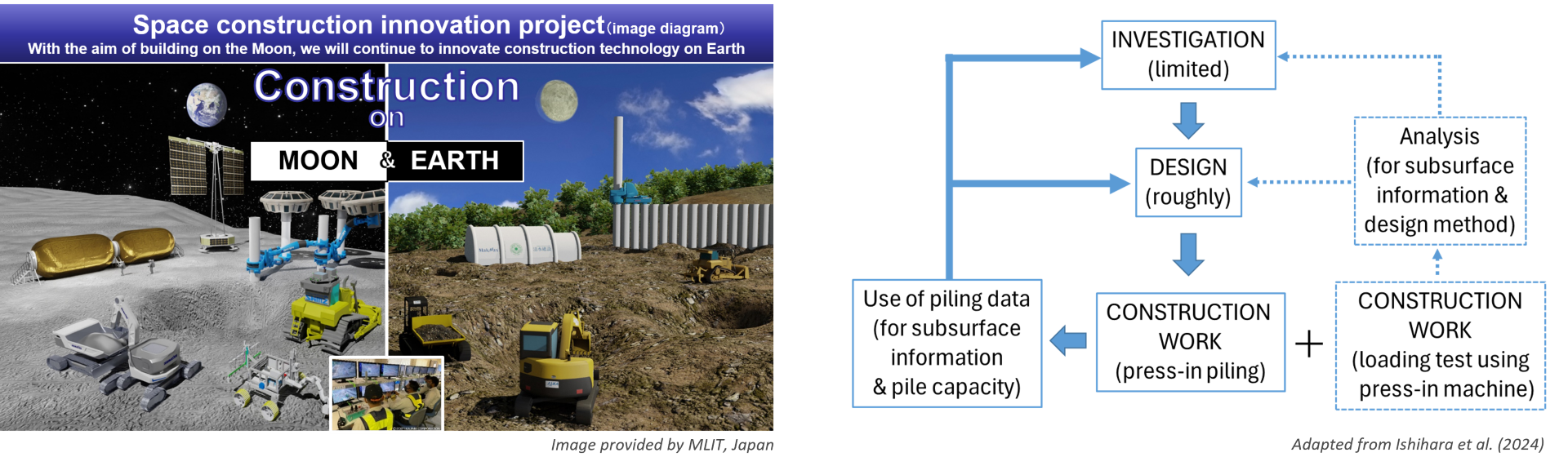
The “Space Construction Innovation Project” is a project led by MLIT (Ministry of Land, Infrastructure, Transport and Tourism) and MEXT (Ministry of Education, Culture, Sports, Science and Technology), launched in 2021. Currently, 12 organizations participate in the project.
We completed the feasibility study (F/S) phase in fiscal year 2021 and have since progressed to the R&D phase, which began in fiscal year 2022. In this phase, we are working to ensure the applicability of technologies that utilize press-in piling data for construction projects on the Moon.
References
Ishihara, Y., Eguchi, M., Mori, A. and Toda, Y. 2024a. Use of press-in piling data for construction on the Moon: estimating subsurface information and pile capacity. Proceedings of the 3rd International Conference on Press-in Engineering 2024, Singapore, pp. 131-140.
Ishihara, Y., Eguchi, M., Mori, A. and Toda, Y. 2024b. Simple static vertical and horizontal loading tests on small pipe piles using press-in machine. Proceedings of the 3rd International Conference on Press-in Engineering 2024, Singapore, pp. 141-147.
Tamboura, H. H., Ishihara, Y. and Ogawa, N. 2024a. Numerical investigation of bearing capacity of pressed-in piles for earth-based innovations and geotechnical strategies for construction projects on the Moon. Proceedings of the 3rd International Conference on Press-in Engineering 2024, Singapore, pp. 148-157.
Sarmah, R., Okada, K., Tamboura, H. H. and Ishihara, Y. 2025. Model tests to assess the temperature generation due to tubular pile installation in lunar regolith simulant by Rotary Cutting Press-in Method. Proceedings of DFI India 2025: Deep Foundation Technologies for Infrastructure Development in India, Surat, Gujarat, pp. 649-658.
Participation in Space Port Kochi

Space Port Kochi is a general incorporated association dedicated to establishing a spaceport in Kochi Prefecture for the launch and landing of rockets. We support their vision and participate as a corporate member.
The spaceport is highly anticipated not only as a driver for regional economic revitalization in Kochi, but also as an initiative that could enhance Japan’s global presence. We envision a future in which our press-in technology plays an active role in supporting these developments.
Further details about Space Port Kochi can be found on its official website: https://spkochi.org/
Compilation of press-in piling case histories
Coming soon
Interaction with academic community
Joint research with Cambridge University
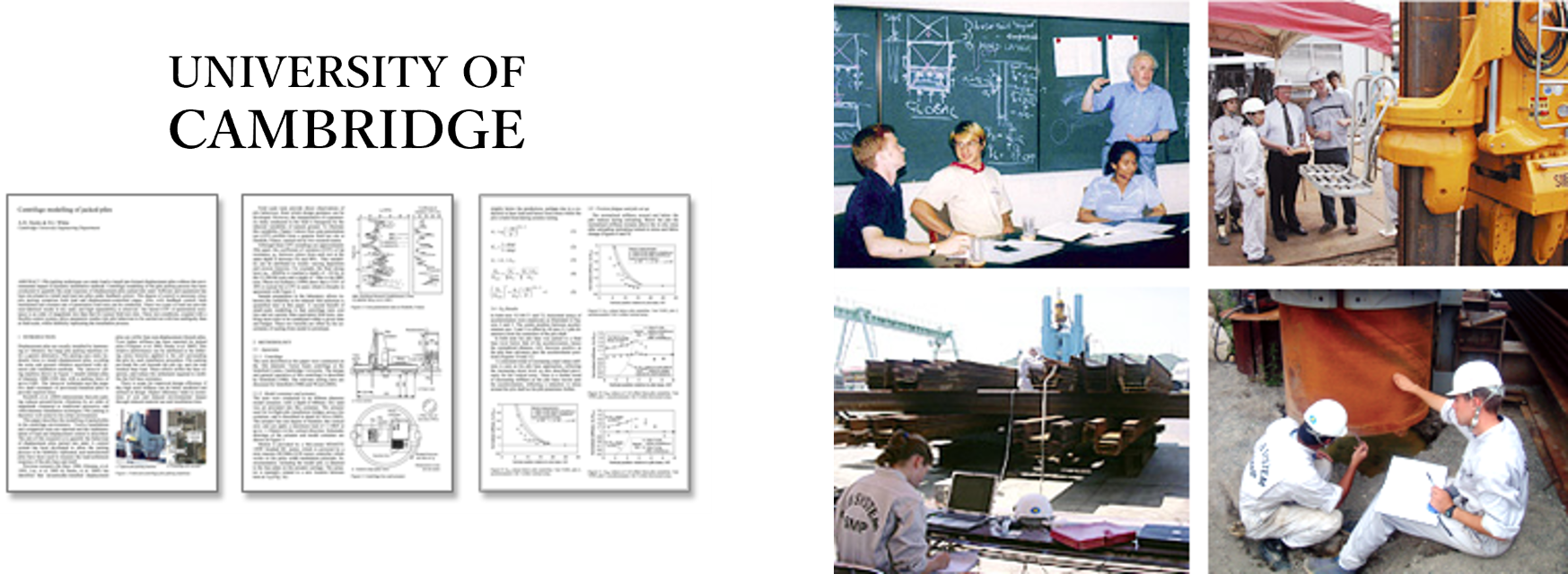
The Cambridge-GIKEN joint research program was initiated in 1994 under the strong vision of Mr. Akio Kitamura, Executive Chairman of GIKEN, with a focus on addressing key challenges in construction. Each summer, two students from the University of Cambridge stay in Kochi to participate in field and model experiments using press-in machines and other experimental facilities.
Through this program, the students gain hands-on experience with press-in technology, while members of the R&D Center benefit by engaging with diverse perspectives and advanced analytical thinking, fostering deeper insights and innovation.
Further details can be found in Ishihara & Haigh (2018).
Reference
Ishihara, Y. and Haigh, S. 2018. Cambridge-Giken collaborative working on pile-soil interaction mechanisms. Proceedings of the First International Conference on Press-in Engineering 2018, Kochi, pp. 23-46.
Themes of joint research with Cambridge University
- 1995-1996 : Effect of water jetting
- 1997-1998 : Investigation into the pressure bulb
- 1998-1999 : Press-in force and pile type / Press-in speed
- 1999-2000: Measurement of soil plug strength
- 2000-2001: Friction cutter / Strain measurement
- 2001-2002: Press-in force and bearing capacity
- 2002-2003: Features of pressed-in group piles / Vibration measurement
- 2003-2004: Load test on groups of pressed-in piles
- 2004-2006: Penetration resistance / Soil plug and bearing capacity
- 2006-2007: Mechanism of increase in pull-out resistance
- 2007-2008: Penetration resistance and set-up
- 2008-2009: Plugging during press-in
- 2009-2010: Effect of repeated penetration and extraction
- 2010-2011: Reduction of penetration resistance during rotary press-in
- 2011-2012: Spatial distribution of pore water pressure during press-in
- 2012-2013: Reduction of friction during rotary cutting press-in in sand
- 2013-2014: Performance of steel sheet pile walls
- 2014-2015: Mechanism of water-binding during rotary press-in in dense sand
- 2015-2016: Verification of the resilience of Implant levees against tsunami
- 2016-2017: Sheet pile wall with and without stabilization of excavation base
- 2017-2018: Mechanism of water jetting
- 2018-2019: Plugging during Rotary Cutting Press-in
- 2019-2020: Performance of pressed-in sheet piles
- 2020-2021: Performance of pressed-in pipe piles in liquefied sand
- 2021-2022: Performance sheet pile wall foundation in liquefiable sand
- 2022-2023: Performance of levee with double sheet pile walls with or without partition walls
- 2023-2024: Geotechnical parameters of liquefied model ground and effect of sand boils on soil behaviour
- 2024-2025: Disaster investigation and mechanism study on sheet pile structures in Noto area
- 2025-2026: Performance of well foundation constructed by Rotary Cutting Press-in